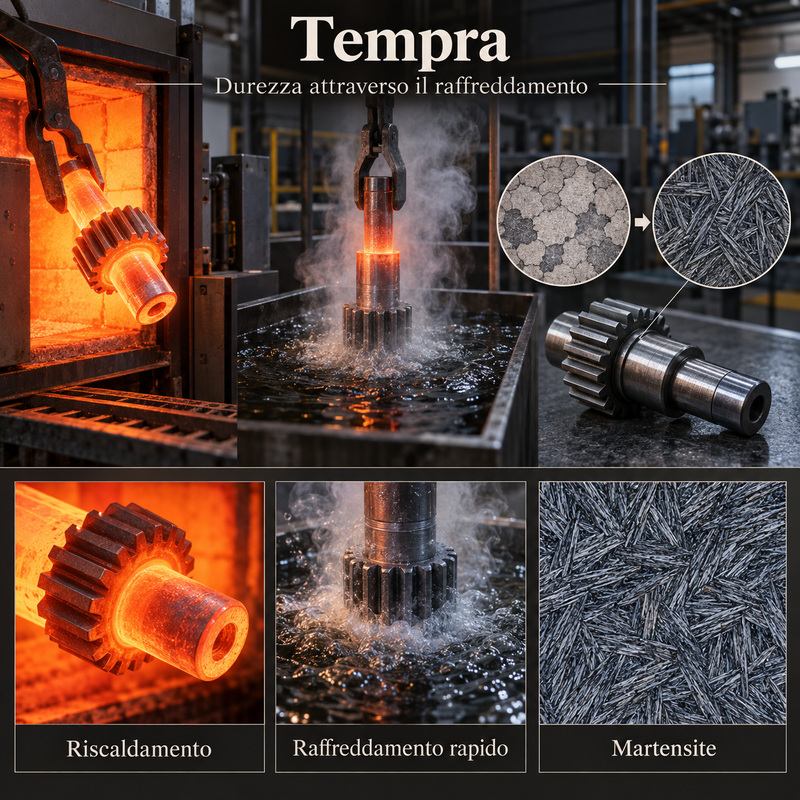
Tempering is a heat treatment used to increase the hardness and mechanical strength of steels. The component is heated to a temperature determined by its composition and then cooled very rapidly.
Cooling prevents the steel structure from slowly returning to its initial state and promotes the formation of a very hard microstructure, called martensite . In the firearms industry, hardening is used for bolts, locks, firing pins, triggers, springs, action frames, tools, and numerous parts subjected to wear or high stress.
How it works
The steel is heated to the austenitization temperature , at which its internal structure transforms and some of the carbon dissolves. The piece must remain at the required temperature for the time necessary to achieve a uniform transformation.
This is followed by rapid cooling using a quenching medium chosen based on the steel type and the component's geometry. The rate must be sufficient to produce hardening, but not so rapid as to cause deformation or breakage.
The stages of tempering
A tempering cycle typically includes:
- progressive heating of the component;
- reaching the austenitization temperature;
- remaining at the set temperature;
- rapid cooling in the quenching medium;
- hardness and deformation control;
- discovery to reduce fragility and tension.
Temperatures and times are not universal, but must be adapted to the composition of the steel, the dimensions of the piece and the required properties.
The formation of martensite
During rapid cooling, austenite transforms into martensite. Carbon remains trapped in the crystalline structure and causes severe deformation of the metal lattice.
This microstructure gives the steel a high level of hardness, but it also presents increased brittleness and strong internal stresses. For this reason, a freshly quenched component is usually not ready for use and must be tempered.
The cooling medium
The cooling rate depends on the medium in which the piece is immersed or exposed. The most common systems include:
- water, very fast but capable of generating strong tensions;
- aqueous and saline solutions;
- oil, less severe and suitable for many steels;
- polymers diluted in water;
- forced air;
- high pressure gas in vacuum furnaces.
The choice represents a compromise between hardening capacity, uniformity, deformations and risk of cracking.
Tempering in water
Water removes heat very quickly and is suitable for steels that require a rapid cooling rate. Contact with the incandescent metal initially produces a layer of vapor that can make cooling less uniform.
It's an effective but severe system. Thin, asymmetrical components, or those with sharp changes in cross-section, can deform or break.
Oil quenching
Oil provides less abrupt cooling than water and reduces the risk of cracking and deformation. It is widely used for alloy steels and precision mechanical components.
Temperature, agitation, and oil conditions must be monitored. The process also requires special attention due to the risk of fumes and fire.
Air and gas quenching
Some alloy steels can be quenched using forced air or pressurized gas. Cooling is more uniform and clean, and dimensional variations can be reduced.
Gas quenching is often combined with vacuum furnaces, in which the component is protected from oxidation and surface decarburization.
Vacuum tempering
Vacuum hardening takes place in a closed furnace with a highly controlled atmosphere. After heating, the piece is cooled using pressurized gas, usually nitrogen or other technical gases.
This process produces clean surfaces, limits oxidation, and improves cycle control. It is particularly suitable for precision components and tool steels.
Hardness and hardenability
Hardness and hardenability are not the same property. Hardness describes a material's resistance to penetration and wear; hardenability indicates the steel's ability to harden through the material.
Two steels can achieve similar surface hardness but exhibit different hardening depths. The alloying elements, component dimensions, and cooling rate influence the transformation.
The role of carbon
The amount of carbon determines the achievable hardness. Low-carbon steels typically do not achieve high hardness through simple quenching and may require treatments such as carburizing or carbonitriding.
A higher content allows for the formation of harder martensite, but also increases brittleness and susceptibility to cracking. Alloying elements can improve hardenability and allow for less drastic cooling.
The discovery
After quenching, the component is reheated to a temperature lower than the austenitization temperature and held for a set time. This treatment is called tempering.
The discovery allows us to:
- reduce internal tensions;
- reduce the risk of sudden breakages;
- increase toughness;
- stabilize the structure;
- adjust the ratio between hardness and resistance.
The combination of quenching and tempering is commonly referred to as hardening and tempering when it is aimed at obtaining high overall mechanical characteristics.
Surface hardening
Not all treatments require hardening the entire component. Surface hardening rapidly heats only the outer area, which is immediately cooled.
The result is a hard surface supported by a tougher core. Localized heating can be achieved through electromagnetic induction or a controlled flame.
Induction hardening
In induction hardening, a coil generates an electromagnetic field that rapidly heats the surface of the component. The cooling medium is then applied immediately.
The process allows for the treatment of selected areas, control of the curing depth, and limitation of core heating. It is suitable for pins, guides, sliding surfaces, and mass-produced components.
Use in weapons
In gunsmithing, tempering is chosen based on the stresses of each part. It can be applied to:
- shutters and locking lugs;
- bascules and contrast surfaces;
- strikers;
- triggers and trigger components;
- levers, pins and hooks;
- springs and elastic parts;
- tools used in production;
- some rods and rod extensions.
Each component requires a specific balance of hardness, toughness, elasticity, and dimensional stability.
Deformations and tensions
During tempering, different areas of the component do not cool simultaneously. Temperature variations and structural transformations cause volume changes that can lead to deformations.
Sharp edges, holes, threads, and abrupt changes in cross-section concentrate stresses. Part design, furnace placement, and cooling methods must be carefully considered to minimize these problems.
Tempering cracks
If stresses exceed the material's strength, quenching cracks can form . These fractures can be immediately visible or detected through nondestructive testing.
The main causes include too rapid cooling, unfavorable geometry, excessive temperature, unsuitable material and delay in performing tempering.
Oxidation and decarburization
Heating in the presence of oxygen can cause oxidation and the formation of scale. A loss of carbon on the surface, called decarburization , can also occur, reducing the external hardness.
To avoid these phenomena, ovens with protective atmospheres, salt baths or vacuum systems are used.
Post-treatment check-ups
After quenching and tempering, the component's hardness, microstructure, dimensions, and integrity are verified. These checks may include:
- Rockwell or Vickers measurements;
- metallographic examinations;
- penetrant tests;
- magnetic particle examination;
- dimensional checks;
- deformation control.
Tempering and case hardening
Case hardening enriches the surface of a carbon-poor steel with carbon. Subsequent quenching transforms the case hardened layer and gives it high hardness.
Case hardening and tempering are therefore not alternatives: in many cycles they work together to obtain a hard surface and a tough core.
Hardening and nitriding
Nitriding diffuses nitrogen into the surface at generally lower temperatures and does not normally require drastic cooling. It produces a very hard layer, limiting deformation.
Tempering, on the other hand, affects the structure of the steel and can harden the entire component or just the surface, depending on the procedure used.
Main benefits
- increased hardness;
- greater mechanical resistance;
- better wear resistance;
- possibility of adjusting hardness and toughness;
- application to the entire component or selected areas;
- wide compatibility with different steels.
Limits of treatment
Quenching can increase brittleness, produce internal stresses, and alter the dimensions of the piece. It therefore requires proper steel selection, a precise heat cycle, and adequate tempering.
Very high hardness is not always the best result. In gunsmithing components, it is often more important to achieve the right balance between hardness, strength, and toughness.
A fundamental treatment
Tempering is one of the most important processes in steelmaking. Controlling heating and cooling allows for profound transformations in the material's behavior.
The safety and durability of a component depend on the correct combination of alloy, geometry, cooling medium and subsequent tempering.