Hard anodizing is an electrochemical treatment used primarily on aluminum alloys to achieve a harder, more wear-resistant, and corrosion-resistant surface. In the gunsmithing industry, it is used on receivers, receivers, forends, slides, grips, chassis, and accessory components.
It's also known as type III anodizing or hardcoat anodizing. Unlike painting, it doesn't apply a foreign film over the metal: it transforms a portion of the aluminum surface into a solid oxide layer.
How it works
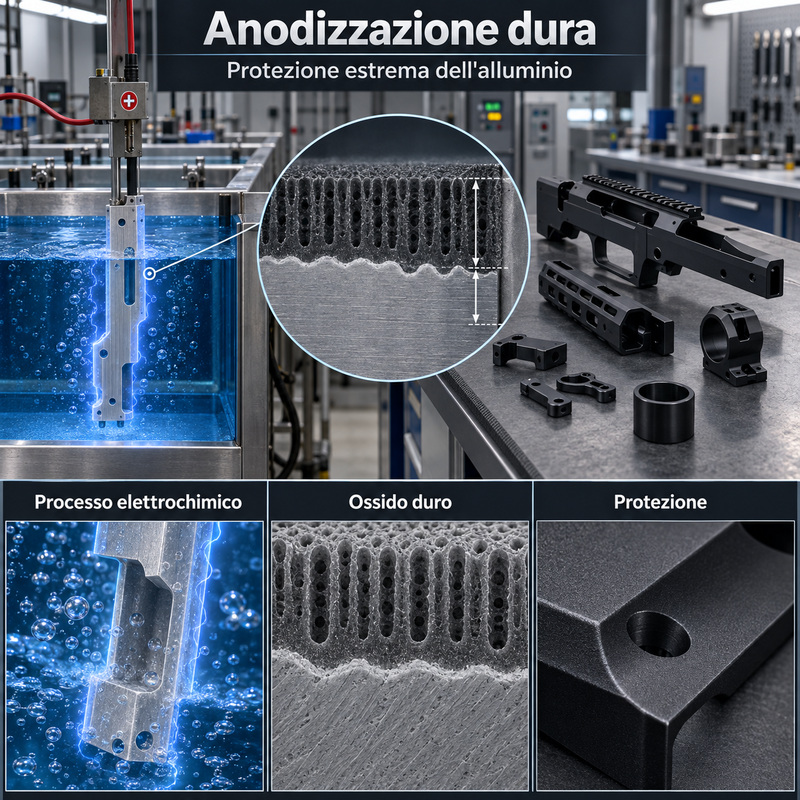
The component is immersed in an electrolytic bath, usually based on sulfuric acid, and connected to the positive terminal of an electrical circuit, becoming the anode . The passage of current causes a controlled reaction that transforms the surface into aluminum oxide.
The process typically includes:
- cleaning and degreasing of the component;
- possible pickling of the surface;
- immersion in the electrolytic bath;
- controlled formation of the anodic layer;
- washing and neutralization;
- possible coloring;
- final sealing of the pores.
The structure of the layer
The anodized layer isn't simply placed on the surface. Part of it grows into the original metal, and part develops outward.
This feature ensures very high adhesion. The layer does not tend to peel like paint, although it can be damaged by impacts, deep abrasions, or deformations of the underlying material.
The structure features microscopic pores that can absorb dyes, lubricants, or substances used during sealing.
Difference from ordinary anodizing
Decorative anodizing, commonly classified as Type II , produces a relatively thin layer, best suited for protecting and coloring surfaces.
Hard anodizing, on the other hand, uses more severe electrical conditions and temperatures. The result is a generally thicker, more compact, and more resistant layer, designed to meet mechanical as well as aesthetic requirements.
Controlled temperatures
During hard anodizing, the bath is kept at low, carefully controlled temperatures. The electric current generates heat and could compromise the evenness of the layer if not dissipated properly.
Controlling temperature, current density, electrolyte concentration, and treatment time determines surface thickness, hardness, and uniformity.
Superficial hardness
Aluminum oxide is significantly harder than the parent metal. This increases resistance to scratches, abrasion, and rubbing.
Actual hardness depends on the alloy, thickness, and process parameters. However, a very hard surface doesn't make the entire component stronger: the core remains the original aluminum alloy.
Corrosion resistance
The anodic layer protects the aluminum from moisture and atmospheric agents. After sealing, the pores are closed or stabilized, reducing the possibility of aggressive substances reaching the underlying metal.
Deep scratches, post-processing, and untreated areas can still expose aluminum. In the presence of dissimilar metals, the risk of galvanic corrosion must also be considered.
Wear resistance
Hard anodizing is particularly suitable for components subject to contact and sliding. The coating can reduce aluminum wear and increase the life of guides, bearing surfaces, and mechanical seats.
Because the oxide is hard but relatively brittle, it should not be subjected to significant deformations. Bending the component can cause microcracks on the surface.
Friction and lubrication
Hard anodizing can be combined with lubricants or substances capable of penetrating the pores of the layer. Some processes involve impregnation with low-friction materials to improve sliding.
However, the treatment does not eliminate the need for lubrication when specified by the manufacturer. Direct contact, dirt, and excessive loads can gradually wear down even an anodized surface.
Thickness and tolerances
The formation of the layer changes the dimensions of the component. As some of the oxide grows outward, holes, seats, guides, and threads may become slightly narrower.
During the design it is therefore necessary to consider:
- expected anodizing thickness;
- variation of final dimensions;
- tolerances between mating parts;
- areas to be masked;
- any work carried out prior to the treatment.
League influence
Not all aluminum alloys react the same way. The presence of copper, silicon, zinc, and other elements can affect color, hardness, uniformity, and corrosion resistance.
Different alloys subjected to the same process can take on different shades. The choice of material must therefore be coordinated with the planned anodizing cycle.
Surface coloring
Hard anodizing typically presents shades ranging from gray, dark bronze, and black . The natural color depends on the alloy and the thickness of the layer.
Before sealing, a dye can be introduced into the pores. Black is very common in gunsmithing applications because it reduces reflections and gives a uniform, technical appearance.
Color alone is not a guarantee of hardness: even a normal decorative anodization can be black.
The sealing
After anodizing, the surface pores can be sealed using a sealing process . This step increases corrosion resistance and stabilizes any coloration.
Some technical applications require a compromise between sealing, hardness, and lubricant retention. The cycle is therefore chosen based on the component's function.
Use in weapons
Hard anodizing is mainly applied to light alloy parts, including:
- castles and carcasses;
- rifle chassis;
- aluminum shafts and handles;
- sleds and mounting interfaces;
- handguards and accessory components;
- turrets and bodies of optical instruments;
- compatible chargers and small parts.
The treatment allows you to exploit the lightness of aluminum while limiting its surface vulnerability.
Surface preparation
Anodizing replicates the appearance of the underlying material. Tool marks, scratches, porosity, and irregularities may remain visible after treatment.
A satin finish can be achieved by sandblasting or controlled micro-sandblasting; a smoother surface requires careful processing and finishing before immersion.
Anodizing and Cerakote
Hard anodizing transforms the aluminum surface and is characterized by very high adhesion. Cerakote , on the other hand, is a ceramic-polymer coating applied over the material.
Anodizing offers hardness, dimensional accuracy, and a technical look. Cerakote allows for a wider color choice and can be applied to different materials, but it forms a separate film.
Anodizing and burnishing
Burnishing is primarily used on steel and produces a subtle dark surface conversion. Anodizing, on the other hand, is used on aluminum and produces a much thicker and harder oxide layer.
The two treatments may appear similar when they have a black finish, but they are based on completely different chemical processes and materials.
Anodizing and painting
The paint adheres to the surface and can chip or peel. The anodized layer, on the other hand, is integrated with the aluminum and offers greater mechanical resistance.
However, a varnish can offer a wider colour range, better cover some irregularities and be more easily repairable.
Main benefits
- high surface hardness;
- good wear resistance;
- corrosion protection;
- strong adhesion to the underlying material;
- reduced tendency to flake off;
- surface electrical insulation;
- possibility of obtaining opaque and low-reflective finishes;
- negligible added weight.
Limits of treatment
Hard anodizing can affect dimensional tolerances and is not suitable for all materials. It cannot be applied to steel using the same process, and its quality depends heavily on the aluminum alloy.
The layer is hard but can fracture if the substrate deforms. Deep scratches and post-treatment work also expose the underlying metal.
Machine maintenance
Anodized surfaces must be cleaned with gentle products, avoiding aggressive abrasives and highly alkaline or acidic substances. The lubricant recommended by the manufacturer should be used in sliding areas.
Discoloration does not always indicate complete removal of the coating, but deep abrasions, cracks, or areas of exposed aluminum require careful inspection.
A functional protection
Hard anodizing combines the lightness of aluminum with a more resistant surface . It is therefore particularly suitable for gunsmithing components where low weight, precision, and durability must coexist.
The final quality depends on the material, preparation, electrochemical parameters and correct sizing of the layer.