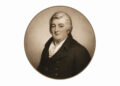
Samuel Colt: biographical information
| Full name | samuel colt |
|---|---|
| Birth | 19 July 1814 |
| Place of birth | Hartford, Connecticut, United States |
| Death | On 10 January 1862 |
| Place of death | Hartford, Connecticut, United States |
| Activities | Inventor, gunsmith, industrialist and entrepreneur |
| Fundamental patent | US Patent No. 138, February 25, 1836 |
| First factory | Patent Arms Manufacturing Company, Paterson, New Jersey |
| Large factory | Colt's Patent Firearms Manufacturing Company, Hartford |
| Symbolic models of their era | Paterson, Walker, Dragoon, Model 1849 Pocket, Model 1851 Navy, Model 1860 Army |
| Main legacy | Practical revolver, large-scale mechanized production, interchangeable parts and industrial marketing |
Hartford: Born in the Heart of New Industrial America
Samuel Colt was born in Hartford, Connecticut, on July 19, 1814. The New England region where he grew up was becoming one of the most important laboratories of American mechanization: textile factories, mills, metalworking, and new machine tools were changing the relationship between craftsmen and production.
His father, Christopher Colt, was involved in the textile industry. Samuel therefore discovered early on a world where the machine was not simply a tool for the craftsman, but could become the center of a production system.
This industrial scale will be essential to understanding its magnitude. Colt didn't just design a mechanism: from the very beginning, he sought a way to transform it into a repeatable, recognizable, and mass-marketable product.
The sea voyage and the idea of the rotating cylinder
One of the best-known stories in Colt's biography concerns his voyage as a teenager aboard the Corvo . According to biographical tradition, while observing the ship's rotating devices, he began to think about a system capable of successively mounting multiple firing chambers in front of a single barrel.
This story must be treated with caution: multi-chamber systems and revolving guns existed before Colt. His contribution was therefore not the absolute invention of the idea of a drum gun.
What he succeeded in doing was developing a combination in which the movement of the hammer rotated the cylinder, bringing a new chamber into line with the barrel, and locking it in the correct position for firing. It's the difference between a concept and a truly usable machine.
1836: The patent that defines the Colt system
On February 25, 1836, Samuel Colt was granted U.S. Patent No. 138 for his improvements in firearms.
The document describes the heart of the solution: a rotating breech with multiple chambers, connected to the battery mechanism so that the operation of the hammer causes the cylinder to rotate and subsequently lock the chamber aligned with the barrel.
The patent therefore protected not simply the presence of a cylinder, but a series of mechanical relationships between the cylinder, hammer, rotation device, and catch. This distinction is essential to correctly interpret Colt's contribution.
Paterson: the first factory and the first failure
In the same year, 1836, Colt started the Patent Arms Manufacturing Company in Paterson, New Jersey. The company manufactured revolvers and also some long, drum-action guns.
The first Patersons already possessed many of the elements that would become characteristic of the brand, but the market didn't respond as needed. Sales were poor, and government orders remained limited. In 1842, the factory ceased operations.
It's a crucial chapter because it shows Samuel Colt far from the image of an infallible industrialist: his first major venture failed. Colt, however, didn't abandon the system.
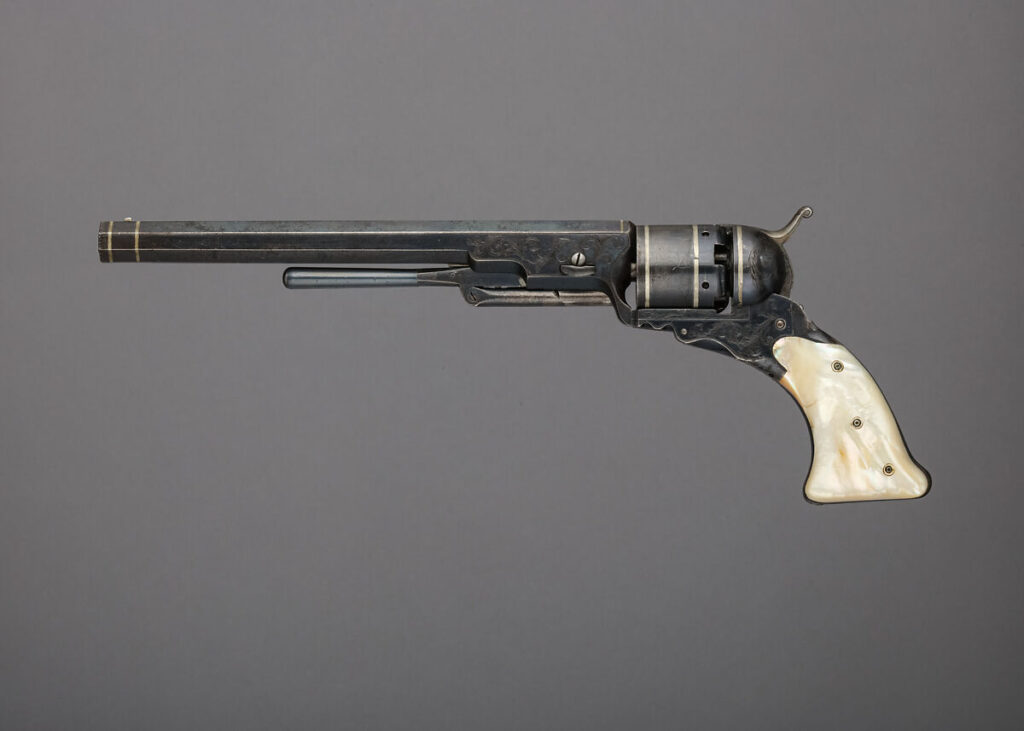
The Colt Paterson: The Gun That Foreshadows the Future
The Paterson was Colt's first commercially produced revolver and represents the stage in which the patented concept had yet to find its definitive form.
The cylinder offered more rounds before reloading and thus a significantly higher firepower than traditional single-shot pistols. Paterson's models included pocket, belt, and holster versions, as well as drum-type long guns.
The history of the Paterson is particularly instructive: a great invention is rarely born perfect. Subsequent models would incorporate a series of improvements suggested by real-world use.
From failure to underwater mines
After Paterson closed, Colt did not remain idle. In the 1940s, he also worked on an underwater mine system, the Submarine Battery , which used electricity to remotely control the explosion.
The project received limited funding from Congress and even involved Samuel F. B. Morse in some experimental aspects. It didn't become the huge success Colt was hoping for, but it shows how his technical interests extended beyond the world of handguns.
Above all, it allowed him to get through the difficult years following the bankruptcy without giving up his ambition to return to revolver production.
Samuel Walker: The Man Who Brought Colt Back into the Gun Industry
The turning point came during the Mexican-American War. Samuel Hamilton Walker, a former Texas Ranger and later an officer in the United States Mounted Rifles, knew the Paterson's potential but also its limitations.
Walker and Colt discussed a new weapon: larger, more powerful, with six .44-caliber rounds, a fixed trigger guard, and a loading lever under the barrel. The result was the Colt Walker of 1847.
A government order for a thousand revolvers gave Colt the opportunity to make a definitive return to the arms industry.
The Walker of 1847: Colt's Return
The Walker was huge compared to later revolvers: a weapon intended primarily for use on horseback, designed to combine firepower and power.
Colt, however, did not yet have a factory capable of producing the order. He turned to the Whitney Armory in Whitneyville, Connecticut, managed by Eli Whitney Jr. Colt brought the design and some of Paterson's experience; Whitney provided the production facility and manufacturing expertise.
The thousand Walkers were completed and Colt was back in business. From this moment on, its industrial history changed radically.
From Walker to Dragoon: Improving Through Experience
The Walker also showed limitations due to its size and high stresses. Colt responded with subsequent Dragoon families, correcting and strengthening various elements.
It's a method we'll find in many great designers: the weapon in the field becomes a test bed. A broken component is strengthened, a problematic lever is modified, an impractical balance is corrected.
Colt's value was therefore not only the initial idea of the rotating cylinder, but the ability to transform user feedback into industrial evolution.
The Model 1849 Pocket: The Revolver Enters Civilian Life
One of Colt's most important business insights was the realization that there was more to the revolver market than just one. The Model 1849 Pocket represented a completely different category from the massive Walker.
It was smaller and more portable, making it suitable for a much wider civilian audience. Colt began segmenting the range by weight, power, size, and intended use.
It's a surprisingly modern product logic: not a single invention, but a platform capable of generating different families.
The Model 1851 Navy: Balance, Reputation, and Circulation
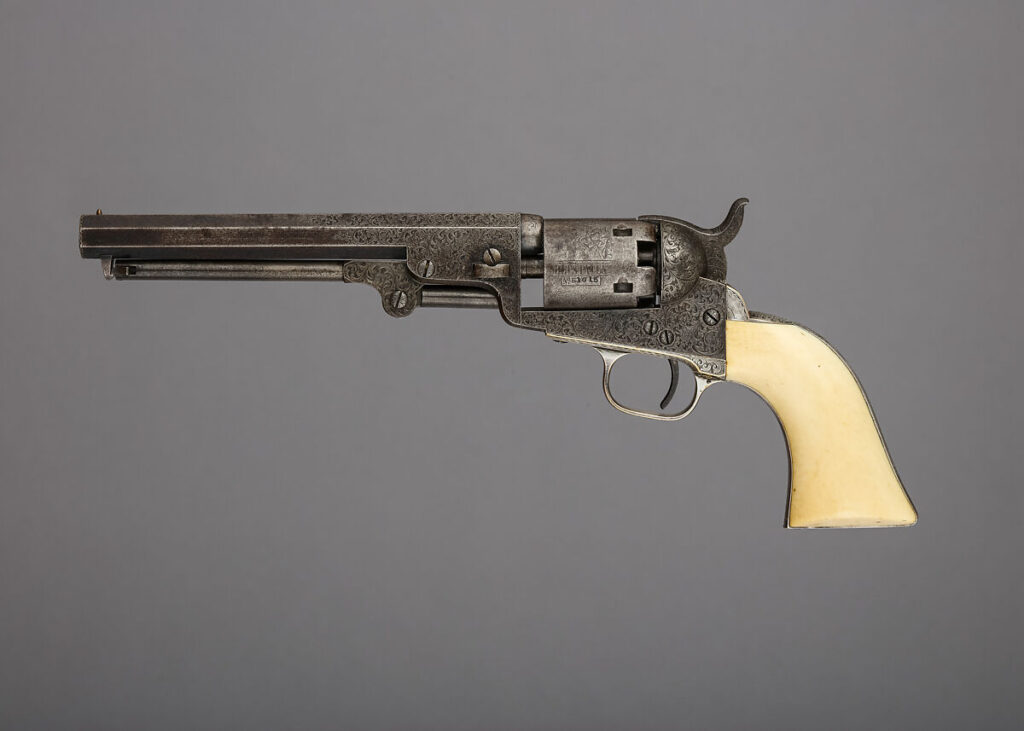
The Model 1851 Navy became one of the most famous and widespread percussion revolvers produced by Colt during the founder's lifetime.
Chambered in .36 caliber, it offered a particularly successful combination of weight, size, and capacity. Its success demonstrates a fundamental design principle: the most powerful model is not always the one that is most popular with the market.
A gun must be powerful enough for its purpose, but also balanced, reliable, portable, and intuitive. The 1851 Navy perhaps better than any other represents the moment when the Colt revolver matured.
The Model 1860 Army: The Maturity of the Percussion Revolver
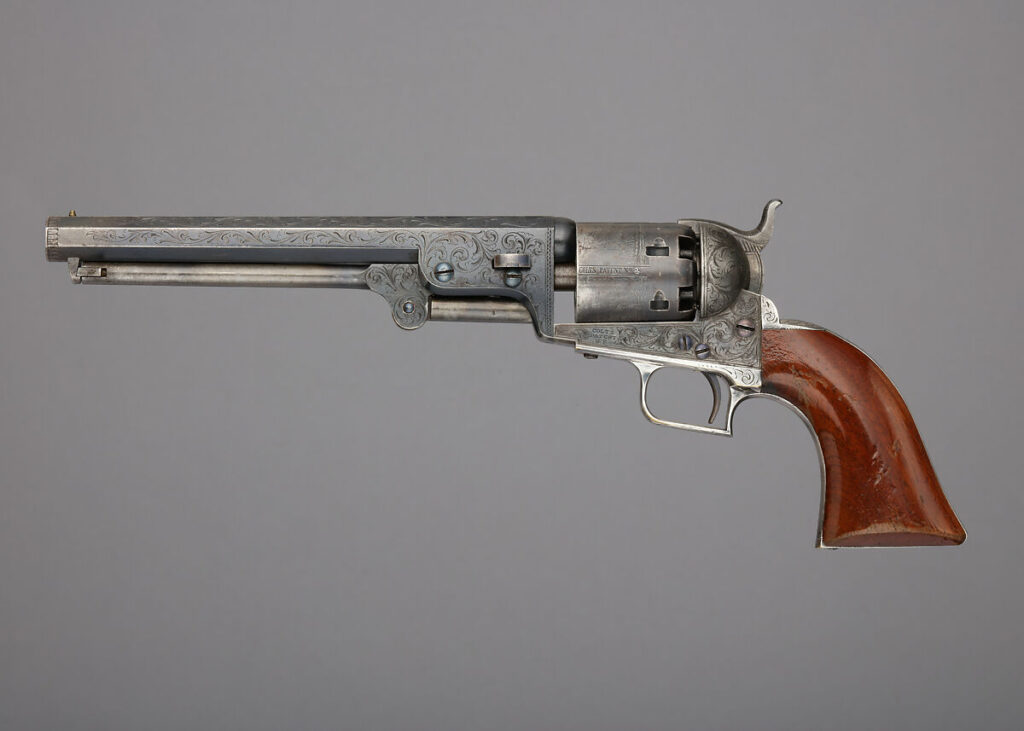
On the eve of the American Civil War, Colt introduced the Model 1860 Army, chambered in .44 caliber. The new weapon offered significant power within a more refined construction than the larger Dragoons.
From a biographical point of view it is particularly significant because it belongs to the last years of Samuel Colt's life and the full maturity of the Hartford plant.
It's also one of the models that shows how far the project had come compared to the first Paterson. The basic logic remains the same; almost everything else has been refined.
Hartford: Colt Builds a Gun-Making Machine
Samuel Colt's second great revolution isn't contained within a revolver. It's the factory.
In the early 1850s, he purchased land in Hartford's South Meadows. By 1855, the large Colt's Patent Firearms Manufacturing Company complex was operational.
Here, specialized machine tools performed repetitive operations with increasing precision. Jigs, gauges, and inspection devices allowed components to be maintained within defined specifications.
Manual labor did not disappear, especially in finishing operations, but the relationship between man and machine changed. The goal was to produce thousands of pieces sufficiently uniform to drastically reduce the manual adjustments typical of traditional weapons.
Interchangeable Parts: The True Industrial Meaning of Colt
The concept of interchangeable parts wasn't invented by Colt: arsenals and manufacturers had been pursuing it for some time. His contribution was to bring it to an extremely effective commercial level in revolver production.
The Smithsonian emphasizes the importance of forging dies, lathes, drills, specialized milling machines, jigs, and testing tools. These tools reduced the variability produced by entirely manual labor.
The consequences were enormous: faster production, more predictable maintenance, the ability to produce large series, and lower unit costs. This is one of the reasons why Samuel Colt's story is also part of the history of American industry.
Elisha K. Root: The Great Engineer Behind the Colt Factory
An accurate reconstruction must avoid personally attributing every innovation born within the company to Samuel Colt. Among the most important men was Elisha K. Root, an extraordinary mechanic and superintendent, who played a key role in the development of Hartford's machine tools and manufacturing processes.
Colt was an inventor, entrepreneur, organizer, and salesman. Around him worked technicians, machinists, engravers, and designers. The factory's greatness arose precisely from the ability to coordinate these skills.
Colt didn't just sell revolvers: he sold the Colt brand.
Samuel Colt was also one of the most formidable marketers of the nineteenth century . He understood that a technically sound gun doesn't automatically sell: it must be made desirable.
He participated in major international exhibitions, including the Great Exhibition in London in 1851. He had richly decorated weapons made for exhibitions and presentations and gave revolvers as gifts to sovereigns, officials, politicians and influential personalities.
The presentation weapons weren't simply gifts. They were communication tools: they simultaneously demonstrated technical prowess, industrial power, and American prestige.
Ormsby, Gustave Young and the Colt Industrial Aesthetic
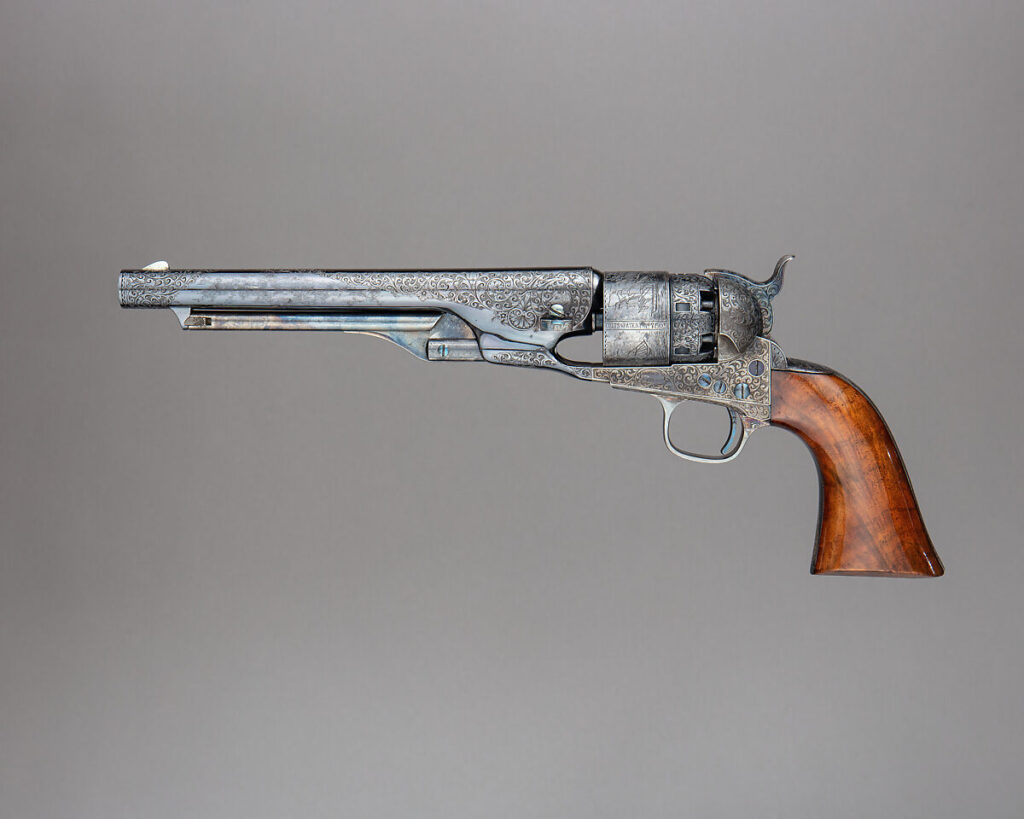
Colt understood that industrial production didn't have to look cheap. The engraved scenes on the cylinders and the decorations on the fine guns became part of the brand's visual identity.
Waterman Lilly Ormsby produced important designs for the cylinders, while engravers like Gustave Young contributed to the company's decorative tradition. The Hartford factory could transform a serial revolver into a highly individualized presentation weapon.
Standardized mechanics and artisanal luxury coexisted in the same production system.
The diplomacy of arms
Colt used revolvers as diplomatic and commercial tools. Particularly opulent examples were presented to sovereigns and high-ranking dignitaries.
The Metropolitan Museum preserves some of these extraordinary objects and documents how the decorated weapons were used for displays, presentations, and gifts to those with the power to influence important purchases.
Colt understood very early on the power of the association between product, celebrity and prestige.
A global entrepreneur
Samuel Colt thought internationally. He traveled to Europe, sought patents and markets outside the United States, attended major exhibitions, and built relationships with various governments.
This strategy transformed Colt from a mere American manufacturer to a global brand . Historical sources also recall controversial aspects of its commercial aggressiveness, including its willingness to seek sales on opposing sides of certain conflicts.
It is an element that fully belongs to the biography of the nineteenth-century entrepreneur and which helps to understand his commercial vision.
Coltsville: A factory that becomes a city
The Hartford complex wasn't just a factory. What is now known as Coltsville grew up around the factory: workers' housing, community spaces, and company-related infrastructure.
The famous East Armory, with its blue dome topped by the prancing horse, became one of the visual symbols of the company.
Colt was building an industrial ecosystem, not just a production line.
The American System of Manufacturing
The Colt factory is often linked to the story of the American System of Manufacturing: components produced using machines and control systems precise enough to reduce individual adjustments.
It wasn't a one-man revolution. Federal arsenals, Whitney, and numerous other manufacturers contributed to its evolution. Colt, however, became one of its most effective commercial demonstrators.
The revolver was the perfect showcase for what the new industry could do: a mechanically complex object, composed of numerous components, built in large quantities and distributed internationally.
The revolver as a platform, not as a single model
One of the reasons for Colt's success was that the rotating cylinder principle could be adapted to different categories.
Paterson, Walker, Dragoon, Pocket, Navy, Army : each family met different needs in terms of weight, power and portability.
Colt wasn't selling a single invention. It was selling a platform capable of generating a range.
Samuel Colt and the Hunt
Paterson's first company also built rifles, carbines, and even revolving-cylinder shotguns. These weapons didn't enjoy the same success as revolvers, but they demonstrate an attempt to transfer the multi-chamber principle to long guns.
Even more significant is the industrial legacy. Standardized production, specialized machine tools, and factory organization influenced the entire American gunmaking industry, including the manufacturers of sporting rifles and shotguns.
Beware the Peacemaker: Samuel Colt never saw it
When talking about Colt, it is easy to attribute all the weapons subsequently produced by the brand to the founder.
The most obvious example is the famous Single Action Army, known as the Peacemaker. Samuel Colt died in 1862; the Single Action Army was introduced in 1873.
It cannot therefore be considered a personal project of Samuel Colt. He built the company and the technical culture that made the model possible, but he was not its author.
Elizabeth Colt: Continuity after Samuel
Samuel Colt died in Hartford on January 10, 1862, at the age of just 47. His death did not mark the end of the enterprise.
His wife, Elizabeth Jarvis Colt, inherited a controlling interest and played a key role in the company's continued existence. After the devastating fire of 1864, the factory was rebuilt and production continued.
The Colt story is therefore also a story of entrepreneurial continuity beyond the founder.
The iconic weapons of the Samuel Colt era
| ModelPeriodHistorical significance | ||
|---|---|---|
| **Colt Paterson** | Since 1836 | First commercial production of the Colt system |
| **Colt Walker** | 1847 | It definitely relaunches Colt's gunmaking career |
| **Colt Dragoon** | Since 1848 | More practical and robust evolution of the Walker concept |
| **Model 1849 Pocket** | Since 1849 | Expansion of the revolver towards the civilian market |
| **Model 1851 Navy** | From 1850/51 | One of the most successful and widespread Colt percussion revolvers |
| **Model 1860 Army** | Since 1860 | Maturity of the large military percussion revolver |
The True Genius of Samuel Colt
Samuel Colt shouldn't be remembered solely as the man behind the revolver. He understood patents, manufacturing, machine tools, work organization, branding, exhibitions, and the power of commercial relationships.
Many inventors succeed in building a prototype. Many industrialists succeed in producing in quantity. Many merchants succeed in selling. Colt succeeded in combining all three dimensions.
Why Samuel Colt is one of the great gunsmiths in history
Samuel Colt lived only 47 years, but in that time he profoundly changed the history of weapons and American industrial production.
The 1836 patent made practical a system in which the cylinder rotated and locked automatically through the movement of the mechanism. The first company failed; Colt restarted. The Walker brought it back to market. The Dragoon, Pocket, Navy, and Army showed that the same architecture could generate profoundly different products.
In Hartford he finally built something even more important: a factory capable of producing complex weapons in large quantities through specialized machinery, dimensional control and increasing interchangeability.
For this reason Samuel Colt belongs to two histories at the same time: to the history of weapons and to the history of modern industry.
His true legacy isn't just the cylinder spinning in front of the barrel. It's the idea that a gun can simultaneously become a mechanical invention, an industrial product, and a global brand.