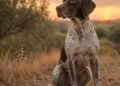
The Weimaraner , commonly known in Italy as the Weimaraner Pointer , is one of the most fascinating and recognizable continental pointing dogs . Its characteristic gray coat, athletic build, and intense expression have helped make it famous throughout the world, but behind its particularly elegant image lies above all a true multipurpose hunting dog , developed according to German canine tradition.
The Weimaraner is not just a pointing dog. Over time, breeding has sought to develop a companion capable of working closely with its handler, identifying game, stopping it, retrieving it after shooting, retrieving, and navigating a variety of terrain and hunting situations.
One of the most interesting characteristics of the breed is its balance between initiative, sense of smell, connection, determination, and versatility . Compared to other pointing dogs that are more focused on speed and range, the Weimaraner generally works in a concrete and methodical manner, in which the relationship with the hunter is of great importance.

Weimaraner: Identity Card of the Weimaraner
| Official name | Weimaraner |
| Name commonly used in Italy | Hound of Weimar |
| country of origin | Germany |
| Hunting category | Pointing dog |
| FCI Classification | Group 7 – Pointing Dogs |
| Section | Continental Pointing Dogs – Pointer Type |
| FCI Standards | N. 99 |
| Test of work | Expected |
| Size | Medium-large |
| Male height | 59-70 cm |
| Female height | 57-65 cm |
| Male weight | Approximately 30-40 kg |
| Female weight | Approximately 25-35 kg |
| Hair variety | Short hair and long hair |
| Colors | Silver grey, roe deer grey, mouse grey and intermediate shades |
| Temperament | Vigorous, balanced, determined and strongly connected to the conductor |
| Main attitude | Multipurpose and stationary hunting |
The Weimaraner's main hunting abilities
| Ferme | ★ ★ ★ ★ ★ |
| Search | ★★★★ ☆ |
| Smell | ★ ★ ★ ★ ★ |
| I'm reporting | ★ ★ ★ ★ ★ |
| Recovery | ★ ★ ★ ★ ★ |
| Work in water | ★★★★ ☆ |
| Resistance | ★ ★ ★ ★ ★ |
| Swift | ★★★★ ☆ |
| Flexibility | ★ ★ ★ ★ ★ |
| Connection with the conductor | ★ ★ ★ ★ ★ |
The ratings indicated are a rough summary of the characteristics typically associated with the breed. The performance of an individual dog depends on selection, pedigree, experience, training, and hunting use.
The Weimaraner in a nutshell: elegance and hunting practicality
The Weimaraner has become famous for its distinctive silver-gray coat and elegance. However, focusing solely on its appearance ignores the true nature of the breed.
The Weimaraner was born primarily as a working and hunting dog . It possesses structure, stamina, scenting abilities, and a strong instinct to cooperate with its handler.
Its hunting behavior generally favors concreteness and systematicity over the relentless pursuit of speed. A good Weimaraner must be able to read the terrain and wind, maintain communication with the hunter, and adapt its actions to the situation.
It is therefore particularly interesting for those who want a complete assistant and want to build a very close working relationship with their dog.
Origins and history of the Weimaraner
The Weimaraner is a German breed with an ancient and fascinating history. Its origins are traditionally associated with the hunting environment of the Weimar court , hence the breed's name.
The reconstruction of its earliest origins is not fully documented, but the Weimaraner's presence as a select population is firmly attested in the 19th century. The breed was subsequently organized through increasingly rigorous selection and pedigree registration.
A particularly significant element of the modern history of the Weimaraner is the desire of German breeders to preserve its identity as a versatile hunting dog.
The selection therefore did not focus only on the morphological aspect or on the point, but on the overall ability to carry out different hunting tasks.
The German Weimaraner Klub , founded at the end of the 19th century, contributed significantly to the preservation and development of the breed, maintaining a strong focus on functional qualities and practical use in hunting.
Weimaraner: A True German Working Dog
To properly understand the Weimaraner, it must be placed within the culture of German all-purpose hunting dogs.
The principle behind this selection is different from that which led to the development of some British specialists. The goal is not necessarily to produce the fastest dog or the one with the widest search, but to create a companion capable of effectively performing various tasks.
Before shooting, he must search, use the wind correctly, locate the game and stop it.
After the shot, he must be able to contribute to the recovery and retrieval.
This setting explains many characteristics of the Weimaraner and above all its marked orientation towards the completeness of hunting work.
Morphology of the Weimaraner
The Weimaraner is a medium-large sized dog with an athletic, lean, and muscular appearance. It should simultaneously express power, endurance, and elegance.
Sexual dimorphism must be recognizable: males and females maintain the typical characteristics of the breed but must be clearly distinguishable.
The head is in proportion to the overall structure, with an attentive and intelligent expression. The ears are broad, relatively long, and pendant.
The neck is muscular and contributes to an overall structure designed to support significant physical activity.
The chest must ensure adequate respiratory capacity, while the back, lumbar region, croup and limbs must offer solidity and ability to move.
Overall, the Weimaraner must appear as what it really is: an athlete intended for hunting work.
The characteristic gray color of the Weimaraner
The coat is undoubtedly one of the elements that have contributed most to the fame of the breed.
The standard provides for different shades of gray , including silver gray, roe gray and mouse gray, as well as their intermediate shades.
The color gives the Weimaraner an immediately recognizable appearance and is very different from most other continental pointing dogs.
However, color should not be the primary criterion when choosing a dog intended for hunting. For a working auxiliary dog, health, balanced character, hunting qualities, and provenance from properly selected lines remain essential.
Short-haired Weimaraner and long-haired Weimaraner
An important peculiarity, sometimes little known by the non-specialist public, is the existence of two officially recognized varieties :
Short-haired Weimaraner and long-haired Weimaraner.
Short-haired Weimaraner
This is the most well-known and widespread variety. The coat is short, strong, and dense, with an extremely clean and elegant appearance.
Maintenance is relatively simple and the dog can be used in a wide variety of hunting conditions.
Long-haired Weimaraner
The long-haired variety, on the other hand, has a more developed, soft coat that varies in structure and length in different parts of the body.
Although numerically less common, it fully belongs to the breed and retains the typical functional characteristics of the Weimaraner.
The Weimaraner Hunting: How It Works
The Weimaraner's hunting behavior is one of the most interesting aspects of the breed.
It shouldn't necessarily be evaluated by looking for the showmanship typical of other breeds. Its strength often lies in its ability to work methodically, with concentration and continuity.
A good subject must demonstrate initiative, but at the same time maintain a clear connection with the handler.
It is precisely this balance between autonomy and collaboration that constitutes one of the most characteristic elements of the Weimaraner.
The search for the Weimaraner
The Weimaraner's search generally tends to be systematic and adapted to the terrain.
It doesn't necessarily have to be excessively fast. The goal is to effectively explore the environment while maintaining the ability to use emanations and wind.
An experienced dog naturally changes its amplitude and speed depending on the terrain.
On the plains he will be able to develop the action more, while in the woods and in complex vegetation he will have to reduce the distance and maintain a closer connection.
This ability to adapt one's search is an important practical quality.
The Weimaraner's sense of smell
Olfactory abilities are one of the breed's strong points.
The Weimaraner must be able not only to detect the scent of game, but to interpret it correctly and follow its evolution.
An experienced dog uses wind, terrain, and vegetation to determine the game's location.
This attitude becomes important both during the search before shooting and during recovery activities and work on the trail.
The Weimaraner Pointing
As a Group 7 dog, pointing is naturally a fundamental characteristic of the Weimaraner.
When it enters the emanation correctly, it must detect the presence of the game and stop its advance with confidence.
However, the quality of the stop must not be evaluated exclusively from an aesthetic point of view.
When hunting, what matters most is the dog's ability to maintain control of the situation and allow the handler to approach without needlessly causing the game to flee.
Experience and frequency of meetings contribute enormously to the maturation of the dog.
Guided and wild management
When the game tends to move on the ground, the dog must be able to adapt its behavior.
The guided requires balance, the ability to use the emanation and above all experience.
A mature Weimaraner can demonstrate particular effectiveness precisely in situations where it is necessary to combine prudence and determination.
Game retrieval and recovery
One of the characteristics that most distinguishes the Weimaraner from a purely specialist vision of the pointing dog is the great importance given to work after the shot.
Recovering shot or wounded game is a key function of the auxiliary.
The Weimaraner generally has a good predisposition for retrieving and can effectively carry out retrieving activities on different terrains.
This characteristic contributes significantly to its reputation as a versatile dog.
The Weimaraner and tracking work
Another particularly interesting ability is the ability to use smell to follow a trail.
Traditional German breeding places great importance on the all-round work of the auxiliary dog, and the Weimaraner can demonstrate remarkable abilities even in post-shooting activities.
Method, perseverance, and a good nose allow a properly trained dog to deal with situations in which it is necessary to reconstruct the game's path.
This is a characteristic that further contributes to the hunting versatility of the Weimaraner.
The Weimaraner and water
The Weimaraner can demonstrate a good predisposition for working in water and for retrieving game in wetlands.
As always, the relationship with water should be developed gradually from the first experiences, avoiding forcing it that could cause insecurity.
A correctly introduced subject can become an effective auxiliary even in this environment.
The ideal terrain for the Weimaraner
| Pianura | ★ ★ ★ ★ ★ |
| Collina | ★ ★ ★ ★ ★ |
| The Forest | ★★★★ ☆ |
| Mountain | ★★★★ ☆ |
| Wetlands | ★★★★ ☆ |
| Very thick vegetation | ★★★ ☆☆ |
Its versatility allows the Weimaraner to face very different hunting environments.
Plain etc.ollinallow you to effectively use your athletic structure, sense of smell and search ability.
In the forest, the connection with the handler and the ability to adapt the width of the search become particularly important.
In humid areas, however, the retrieving qualities and the predisposition to work in water can emerge.
What game can you hunt with a Weimaraner?
The versatile nature of the Weimaraner allows it to be used on numerous game species.
Pheasant
Attitude: ★★★★★
The pheasant allows the Weimaraner to express many of his qualities: searching, ability to interpret emanations, pointing, possible driving and subsequent retrieval.
Gray partridge
Attitude: ★★★★☆
Partridge hunting highlights olfactory abilities, use of the wind and systematic search methods.
Quail
Attitude: ★★★★☆
The good nose and working method allow the breed to effectively deal with this type of game as well.
Partridge
Attitude: ★★★★☆
Athleticism and endurance are useful characteristics when working on physically demanding terrain.
Woodcock
Attitude: ★★★★☆
The strong bond with the handler and the ability to adapt the search can also make the Weimaraner interesting for woodcock hunting , especially when the subject has specific experience in the woods.
Water game
Attitude: ★★★★☆
The retrieving qualities and the predisposition to work in water broaden the possibilities of employment of the breed.
How to recognize a good Weimaraner on the ground
A good Weimaraner does not necessarily have to be the dog that develops the most spectacular or fastest action.
Quality must be sought above all in the overall functionality of the work.
It should be noted:
search method, olfactory ability, use of the wind, initiative, connection, safety when pointing, adaptation to the terrain, retrieval ability and willingness to cooperate.
The great subject is the one who manages to use these characteristics in a balanced and, above all, effective way.
Weimaraner character
The Weimaraner generally has a strong, energetic temperament and is very attached to its handler.
He is intelligent, receptive and requires an ongoing relationship with his owner.
This feature can be a huge advantage during hunting because it promotes the dog-hunter connection , but it also requires consistent management.
This isn't a dog to be left inactive for long periods. It needs exercise, stimulation, and activity year-round.
The relationship between Weimaraner and hunter
Probably one of the elements that best characterizes the Weimaraner is the relationship it establishes with its handler.
The dog must develop sufficient autonomy to face the search and make decisions on the ground, but at the same time maintain a strong willingness to collaborate.
When this balance is properly built, the Weimaraner can become an extremely reliable hunting companion.
Weimaraner Training
Training a Weimaraner should be based on a balance between discipline, trust, and the appreciation of natural predispositions.
Education of base
Recall, relationship with the handler and correct socialization are the foundations on which to build subsequent hunting work.
First releases
The young dog must be able to explore the terrain and gradually develop initiative and confidence.
Excessive control can limit the very decision-making skills that will later be crucial during the hunt.
Encounter with the wild
Proper experiences with real game are of fundamental importance.
The young Weimaraner must gradually learn to interpret the emanations and above all the behavior of the different species.
Ferme
Natural predisposition must be consolidated through experience and education, avoiding excessively rigid interventions that could reduce initiative and confidence.
I'm reporting
Retrieving is an important component of the breed's work and should be developed gradually until reliable behavior is achieved.
Work in water
The approach must be progressive and positive, allowing the dog to gain confidence in the aquatic environment.
Weimaraner athletic training
The Weimaraner's structure is that of a dog capable of sustaining significant physical activity, but for this very reason athletic preparation must not be neglected.
Conditioning must be built gradually before the hunting season begins.
Particular attention should be paid to cardiovascular endurance, musculature, body weight, foot condition, hydration and recovery.
A properly trained dog works better, recovers more quickly and faces demanding hunting days with greater confidence.
Weimaraner Health and Management
When choosing a puppy, it is important to turn to breeders who pay attention not only to morphology, but also to the health, character, and functional qualities of the breeders.
As with many medium-large breeds, it is advisable to carefully evaluate any health checks required by selection programs, particularly those relating to the musculoskeletal system and any hereditary pathologies known to exist in the breed.
The working dog also requires appropriate management throughout the year, including activity-appropriate nutrition, weight control, regular exercise, and veterinary monitoring.
Is the Weimaraner the right hunting dog for you?
| Hunting versatility | ★ ★ ★ ★ ★ |
| Smell | ★ ★ ★ ★ ★ |
| Energy | ★ ★ ★ ★ ★ |
| Resistance | ★ ★ ★ ★ ★ |
| Trainability | ★★★★ ☆ |
| Connection with the conductor | ★ ★ ★ ★ ★ |
| Need for physical activity | ★ ★ ★ ★ ★ |
| Versatility of the soils | ★★★★ ☆ |
| Suitable for the active hunter | ★ ★ ★ ★ ★ |
The Weimaraner is particularly interesting for the hunter who wants a complete, collaborative dog capable of facing different hunting situations.
However, it requires time, movement, communication, and consistent management. It's therefore not the ideal choice for those looking for a companion to use exclusively during a few days of the hunting season.
Weimaraner: Strengths and Aspects to Consider
| Key features | Aspects to consider |
|---|---|
| Great hunting versatility | High need for movement |
| Excellent olfactory abilities | It requires a constant relationship with the host |
| Good stop | Needs consistent education |
| Excellent predisposition to recovery | Energy must be correctly directed |
| I'm reporting | Athletic preparation is important |
| Strong connection with the hunter | Choosing the bloodline is important |
| Good predisposition to water | Not suitable for an excessively sedentary lifestyle |
| Adaptability to terrain | Requires experience and continuity in work |
Weimaraner and Kurzhaar: Two Great German Continentals Compared
The comparison between Weimaraner and Kurzhaar is particularly interesting because both breeds belong to the great German tradition of continental pointing dogs, but interpret their work with different characteristics.
The Kurzhaar generally tends to express a brilliant, athletic and dynamic action, with great balance between searching, speed, pointing and retrieving.
The Weimaraner particularly emphasizes systematic work, a strong bond with the handler, olfactory ability and a predisposition for versatility before and after the shot.
The differences between individual subjects and selection lines can naturally be significant, but knowing the different settings of the two breeds helps the hunter to identify the dog best suited to his needs.
Weimaraner and Drahthaar
The comparison with the Drahthaar also allows us to better understand the philosophy of the German selection.
Both breeds are highly versatile, but the Drahthaar has a particularly protective coat, designed to cope with difficult vegetation, water, and challenging weather conditions.
The Weimaraner, on the other hand, maintains a different structure and image, accompanied by a particularly close relationship with the handler and notable hunting versatility.
Weimaraner-like breeds to know
Anyone who appreciates the characteristics of the Weimaraner should also look into other important continental pointing dogs.
Kurzhaar – one of the most complete and widespread German continentals, athletic, fast and versatile.
Drahthaar – German wire-haired dog with extraordinary versatility and a particular ability to cope with difficult environments.
Italian Pointer – a historic Italian breed characterized by a particular working style and important olfactory qualities.
Spinone Italiano – robust and methodical continental breed, appreciated above all for its solidity and ability to tackle challenging terrain.
Brittany Spaniel – a compact and dynamic dog that combines small size, great hunting passion and remarkable versatility.
Why choose a Weimaraner for hunting?
Choosing a Weimaraner means choosing a complete hunting dog , in which beauty and elegance represent only the most immediately visible part of a much more important functional heritage.
Pointing, smell, ability to search, retrieve, retrieve, predisposition to work in water, endurance and above all a strong bond with the handler are the fundamental elements of the breed.
The Weimaraner probably expresses the best of its qualities when it is considered not as a simple pointing dog, but as a versatile auxiliary dog capable of accompanying the hunter throughout the entire hunting action.
A properly selected, properly educated, trained, and regularly taken out on the field dog can become an extremely effective hunting companion, capable of combining method, determination, elegance, and an extraordinary relationship with its handler.