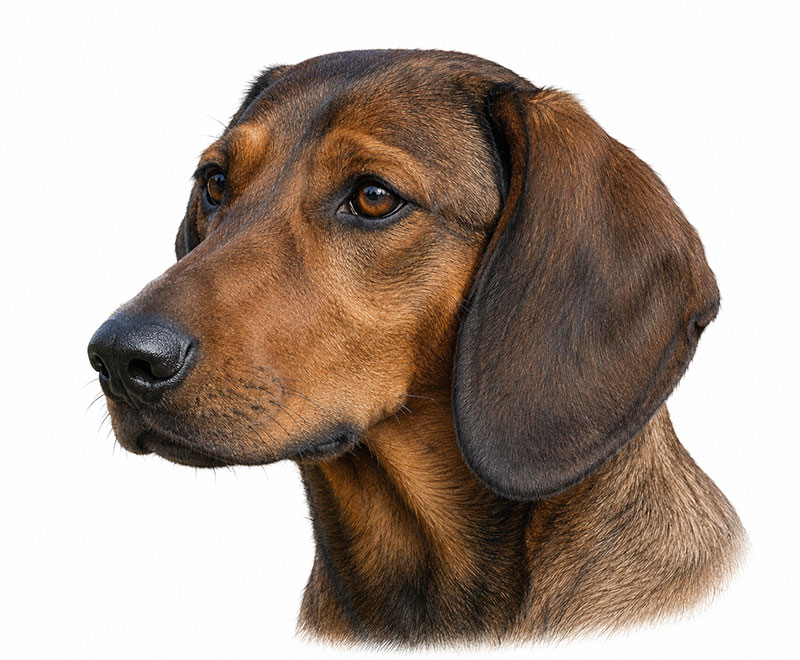
The Alpenländische Dachsbracke , also known as the Alpine Dachshund , is an Austrian hunting dog particularly prized for tracking wounded game and for its ability to operate effectively in difficult mountain environments. Low-limbed, robust, weather-resistant, and endowed with great perseverance, it is one of the European breeds most closely linked to the tradition of hunting retrieval.
Its morphology may superficially resemble that of a small dog, but the Alpenländische Dachsbracke is actually an extremely solid and determined helper , designed to work for hours on rough terrain, follow complex scent trails and maintain concentration even when the trail becomes difficult.
The breed is primarily used for hunting wounded ungulate game , but Alpine hunting tradition also includes its use as a hound for hares and foxes. It is therefore a dog in which smell, method, endurance, and connection with its handler are far more important than speed.
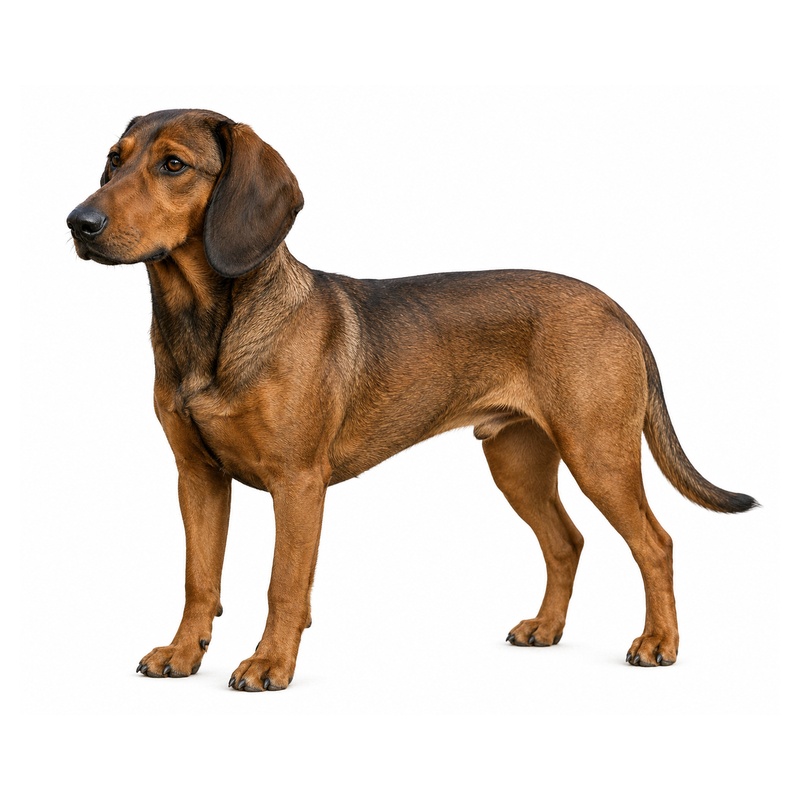
Alpenländische Dachsbracke: identity card
| Official name | Alpenland roof bracke |
| Commonly used Italian name | Alpine Dachshund |
| English name | Alpine Dachsbracke |
| country of origin | Austria |
| Hunting category | Tracking dog and hound |
| FCI Classification | Group 6 – Scenthounds and related breeds |
| Section | Section 2 – Tracking Dogs |
| FCI Standards | N. 254 |
| Test of work | Expected |
| Size | Small-medium, low on the limbs |
| Height at the withers | 34-42 cm |
| Ideal height for men | 37-38 cm |
| Ideal height for females | 36-37 cm |
| cloak | Double, dense, tight-fitting and weatherproof |
| Typical colors | Dark deer red or black and tan |
| Temperament | Intelligent, balanced, courageous and determined |
| Main attitude | Search for wounded game |
The main hunting skills of the Alpenländische Dachsbracke
| Work on the track | ★ ★ ★ ★ ★ |
| Smell | ★ ★ ★ ★ ★ |
| Perseverance | ★ ★ ★ ★ ★ |
| Recovery of the wounded wild animal | ★ ★ ★ ★ ★ |
| Resistance | ★ ★ ★ ★ ★ |
| Work in the mountains | ★ ★ ★ ★ ★ |
| Work in the forest | ★ ★ ★ ★ ★ |
| Weather resistance | ★ ★ ★ ★ ★ |
| Swift | ★★★ ☆☆ |
| Connection with the conductor | ★ ★ ★ ★ ★ |
The ratings provided are indicative and describe the aptitudes typically associated with the breed. The individual's capabilities depend on selection, pedigree, experience, training, and the type of work performed.
The Alpenländische Dachsbracke in a nutshell: track specialist
To truly understand the Alpenländische Dachsbracke, one must forget its size for a moment and look at the function for which it was selected.
It is a dog built to follow a trail with method, perseverance and concentration , tackling terrain where a taller and faster assistant might encounter greater difficulty.
His actions must be carefully considered. It's not how quickly he can cover the terrain that matters, but how accurately he can interpret scents, identify the right trail, and maintain continuity in his work.
When recovering a wounded game animal, this ability takes on fundamental importance because a trail can be long, discontinuous, contaminated by other odors, and made even more complex by weather conditions.
Origins and history of the Alpenländische Dachsbracke
The Alpine Dachsbracke belongs to the great tradition of Alpine hunting dogs . Subjects with similar characteristics have long been used by hunters in mountainous regions, where a robust, low-limbed dog capable of effectively tracking game over difficult terrain was needed.
The breed's documented history is particularly interesting. By the end of the 19th century, the Alpine Dachsbracke was already being used by professional hunters within the Austro-Hungarian imperial circle.
In 1881 and 1885, Crown Prince Rudolf of Habsburg had some of his gamekeepers from Mürzsteg and Ischl accompanied by dogs of this type on hunting trips to Turkey and Egypt.
In 1932 the breed, then referred to as Alpenländisch-Erzgebirgler Dachsbracke , was recognized by the main Austrian canine organizations.
In 1975 the name was changed to the current Alpenländische Dachsbracke and Austria was officially recognized as the country of origin.
In 1991 the breed was included by the FCI in the section dedicated to tracking dogs , a position that perfectly summarizes its main functional vocation.
Why is it called Dachsbracke?
The German name Dachsbracke identifies a particular type of hound characterised by relatively short limbs and an elongated body.
The purpose of this construction is not purely morphological. The low center of gravity and compact structure allow the dog to move efficiently through woods, slopes, and vegetation, maintaining a pace particularly suited to scent work.
The definition Alpenländische instead directly recalls the Alpine environment in which this breed developed and in which it is still able to fully express its characteristics today.
Morphology of the Alpenländische Dachsbracke
The Alpine Dachsbracke is a low-set, robust, and well-built dog . The bone structure must be strong and the muscles well-developed, without compromising agility and mobility.
The body is elongated and powerful, a characteristic that contributes to the dog's stability on uneven terrain.
The head should express intelligence and determination. The muzzle is strong, the nose is black, and the eyes generally have dark brown irises.
The ears are set high, pendant, broad and free from folds, with rounded tips.
The neck is muscular, while the chest, back and lumbar region must enable the dog to sustain prolonged work.
The limbs appear short in relation to the body, but should be strong, straight and solidly built.
Proportions and structure of the Alpine Dachshund
The standard places particular importance on the overall proportions of the breed.
The ratio between height at the withers and length of the body is approximately 2:3 . This construction determines the characteristic low and elongated profile of the dog.
However, it should not be interpreted as a fragile or light dog. On the contrary, the Alpine Dachsbracke should appear as a very solid dog, capable of tackling mountain and forest terrain while maintaining stability and endurance.
The coat of the Alpenländische Dachsbracke
The coat represents another fundamental component of the breed's functionality.
It consists of a very dense topcoat and a dense undercoat that completely covers the body.
This structure offers good protection against cold, humidity and adverse weather conditions.
This is a particularly important characteristic for a dog developed to accompany the hunter in the Alpine regions during different periods of the year.
The colors of the Alpenländische Dachsbracke
The ideal colour is considered dark deer red , possibly with a light presence of black hairs distributed throughout the coat.
Black coloring with well-defined red-brown markings on the head, chest, limbs, feet and underside of the tail is also expected.
A small white star on the chest is permitted.
The Alpine Dachsbracke on the hunt: how it works
The work of the Alpenländische Dachsbracke is profoundly different from that of a pointing dog or a scenthound selected primarily for speed and range.
The breed must work above all through smell, concentration, method and perseverance.
When following a trail, it must be able to maintain its olfactory reference even when the trail crosses difficult terrain, changes direction, or is contaminated by the presence of other animals.
The dog must also work in collaboration with the handler, especially when retrieving wounded game.
Work on the Alpenländische Dachsbracke trail
The track represents the true specialization of the breed.
During work, the dog must proceed methodically, continuously checking the olfactory information coming from the ground and the environment.
A track can change intensity, be interrupted by watercourses, cross paths frequented by other animals, or be affected by wind, rain, and temperature.
The experienced dog must learn to distinguish the interesting trail from the surrounding olfactory noise, avoiding easily abandoning the task.
This ability to maintain concentration is one of the most important qualities of a true tracking dog.
Alpine Dachsbracke and the recovery of injured ungulates
One of the most important uses of the Alpenländische Dachsbracke is the search for wounded ungulates.
In post-shot recovery, the dog must be able to follow a trail even when there is little or no visible blood and the animal has traveled significant distances.
It's a job that requires great balance. The dog must not proceed hastily, but must maintain method and precision.
The function of the tracking dog also takes on great importance from the point of view of correct hunting management , because it allows us to reduce the risk of leaving injured animals on the ground.
The Alpenländische Dachsbracke in roe deer hunting
The search for wounded roe deer has historically been one of the most representative uses of the breed.
The dog must be able to locate and maintain an often delicate track through woods, clearings and uneven terrain.
The low build, good sense of smell and perseverance are particularly suited to this type of work.
Naturally, the effectiveness depends on the specific preparation of the subject and the experience acquired during real recovery situations.
The Alpenländische Dachsbracke in deer hunting
The breed can also be used for the recovery of wounded deer , an activity in which resistance, olfactory ability and great perseverance are essential.
Deer can travel considerable distances after being wounded and cross particularly challenging environments.
In these situations the dog must be able to maintain the task for prolonged periods without losing concentration.
The Alpenländische Dachsbracke on the wild boar
Using it on wild boar always requires special experience and caution. The Alpine Dachsbracke can be used to retrieve wounded game thanks to its tracking ability, but these are potentially challenging and dangerous situations.
The dog must possess balance, courage and the ability to assess game without transforming determination and passion into recklessness.
For this type of work, the character selection, the dog's experience and the handler's competence become decisive.
The Alpenländische Dachsbracke as a hound for hares and foxes
The breed standard does not limit its use exclusively to retrieving. The Alpine Dachsbracke has also traditionally been used as a hare and fox hound.
In this work, olfactory abilities, perseverance and the ability to follow the trail while maintaining continuity emerge.
The relatively low speed compared to taller hounds does not necessarily constitute a limitation: the breed's identity is based above all on the ability to track with precision and method.
The voice during work
When used as a hound, the voice allows the hunter to interpret the action even when vegetation prevents the dog from being seen.
Vocal behavior therefore plays a functional role in following the evolution of the action and understanding the position and movement of the auxiliary.
As with all work characteristics, quality, frequency, and modality may vary between individual subjects and selection lines.
The Alpine Dachshund in the mountains
The mountain is the environment in which the Alpenländische Dachsbracke probably most clearly shows the logic of its construction.
A low center of gravity, sturdy limbs, strong body, and protective coat allow the dog to tackle slopes, woods, and uneven terrain while maintaining stability.
The relatively controlled pace is also particularly suited to track work, where precision and the ability to continuously read the terrain are more important than pure speed.
The ideal terrain for the Alpenländische Dachsbracke
| Mountain | ★ ★ ★ ★ ★ |
| The Forest | ★ ★ ★ ★ ★ |
| Collina | ★ ★ ★ ★ ★ |
| Rough terrain | ★ ★ ★ ★ ★ |
| Dense vegetation | ★★★★ ☆ |
| Pianura | ★★★ ☆☆ |
The Alpenländische Dachsbracke can of course also work in different environments, but forest, collinae mountain particularly enhance its characteristics.
The breed doesn't require large open spaces to thrive. On the contrary, complex terrain highlights endurance, method, and the ability to track accurately.
Which game goes with Alpenländische Dachsbracke?
roe
Recovery Aptitude: ★★★★★
The recovery of wounded roe deer represents one of the most traditional uses of the breed and allows us to enhance its sense of smell, method and perseverance.
Porto Cervo
Recovery Aptitude: ★★★★★
Endurance and the ability to keep track over long distances make the Alpenländische Dachsbracke particularly interesting for deer as well.
Boar
Recovery Aptitude: ★★★★☆
Its olfactory qualities allow it to be used on the trail of a wounded wild boar, but the characteristics of the game require specific preparation, caution and experience.
Lepre
Attitude: ★★★★☆
The breed's tradition also includes hare-hound work, which demands perseverance and the ability to follow the trail.
Fox
Attitude: ★★★★☆
The fox represents another use traditionally associated with the Alpenländische Dachsbracke.
How to recognize a good Alpenländische Dachsbracke on the ground
A good subject should not be judged by looking for spectacularity or speed.
The really important features are:
smell, precision, concentration, perseverance, balance, ability to discriminate the track, endurance, connection and determination.
The great tracking dog must give the impression of working patiently and confidently, verifying olfactory information without allowing himself to be unnecessarily distracted.
The ability to correct yourself when you momentarily lose track is just as important as the ability to follow it.
Character of the Alpenländische Dachsbracke
The standard describes a dog with an intelligent and friendly expression and a courageous character.
When hunting, it must demonstrate determination and confidence without losing balance.
A strong relationship with the handler takes on particular importance when tracking, where dog and retriever must form a true team.
Despite its compact build, it should not be considered a simple companion dog: it is a true helper selected to carry out a demanding activity.
The relationship between Alpenländische Dachsbracke and the handler
In tracking work, the relationship between dog and handler is particularly close.
The retriever must learn to read the dog's behavior : changes in gait, posture, intensity of the search and sudden changes in direction can provide important information on the evolution of the track.
At the same time, the dog must develop trust in its handler and learn to work methodically without constantly depending on external indications.
The quality of the duo therefore represents one of the fundamental elements of success in recovery.
Training of the Alpenländische Dachsbracke
The training of the Alpenländische Dachsbracke must be built progressively, developing above all the olfactory abilities, concentration and relationship with the handler.
Education of base
Recall, socialization and daily management are the starting point.
A dog intended for tracking must be balanced and capable of working even in the presence of numerous environmental stimuli.
First artificial slopes
The first exercises must be simple and relatively short, so as to allow the young dog to understand the work required.
Over time, it is possible to progressively increase the length, difficulty and time elapsed since the preparation of the track.
Odor discrimination
One of the most important skills is learning to maintain the assigned trail even when the scents of other animals are present on the ground.
This skill requires experience and numerous properly set up exercises.
Working on old tracks
Gradually the dog must learn to deal with increasingly older tracks, a condition that better simulates the difficulties encountered during real retrievals.
Field experience
As with any working dog, artificial training is only part of the training process. Real, properly managed experience allows the dog to gradually acquire maturity and the ability to interpret ever-changing situations.
Physical preparation of the Alpenländische Dachsbracke
The sturdy structure should not make you think that the dog does not need training.
A trail can extend for miles through slopes, forests, and rugged terrain. Stamina, muscle strength, and good foot condition are therefore essential.
Physical preparation must be progressive and maintained throughout the year, especially in subjects regularly used in the recovery of ungulates.
After-work care
After a long outing, it is advisable to check the dog carefully.
Particular attention should be paid to the feet, pads, interdigital spaces, ears, eyes and coat.
Working in the woods and among vegetation can cause small abrasions or encourage the presence of thorns, seeds, and parasites.
Hydration, nutrition and recovery after major efforts must also be managed correctly.
Health and management of the Alpenländische Dachsbracke
When choosing a puppy, you should favor breeders who carefully select for health, character balance, functional morphology and quality of work.
A tracking dog must possess not only an excellent sense of smell, but also a physical structure capable of sustaining prolonged activity and a balanced temperament.
Weight control, regular exercise, parasite prevention and periodic veterinary visits help keep the dog in suitable condition for hunting.
Is the Alpine Dachsbracke the right hunting dog for you?
| Work on the track | ★ ★ ★ ★ ★ |
| Smell | ★ ★ ★ ★ ★ |
| Perseverance | ★ ★ ★ ★ ★ |
| Resistance | ★ ★ ★ ★ ★ |
| Work in the mountains | ★ ★ ★ ★ ★ |
| Work in the forest | ★ ★ ★ ★ ★ |
| connection | ★ ★ ★ ★ ★ |
| Swift | ★★★ ☆☆ |
| Size manageability | ★ ★ ★ ★ ★ |
| Need for activity | ★★★★ ☆ |
The Alpenländische Dachsbracke is particularly suitable for the hunter interested in recovery of ungulates and working on the track, especially in wooded areas, collinair and mountains.
However, it is less suitable for those looking for a dog characterised above all by great speed, a wide range of search or spectacular action.
Its quality lies in precision, perseverance and the ability to tackle an olfactory problem until it is solved.
Alpine Dachsbracke: Strengths and Aspects to Consider
| Key features | Aspects to consider |
|---|---|
| Excellent track skills | Requires specific training |
| Great sense of smell | It is not a dog selected for speed |
| High perseverance | Recovery work also requires experience from the handler |
| Robustness | The low frame requires attention to physical condition |
| Weather resistance | Requires regular activity |
| Excellent in mountainous terrain | Correct character selection is important |
| Strong connection with the conductor | Wild boar recovery requires particular caution |
| Manageable size | It is a specialized breed that must be able to work |
Alpenländische Dachsbracke and Hannoverischer Schweisshund: what are the differences?
The comparison between the Alpine Dachsbracke and the Hannoverischer Schweisshund is particularly interesting because both breeds are used for tracking wounded game.
The Hannoverischer Schweisshund has a more important structure and is deeply linked to the German bloodhound tradition.
The Alpenländische Dachsbracke, on the other hand, is much more compact and low-limbed, a characteristic that makes it particularly interesting in Alpine territories and difficult terrain.
Both require excellent olfactory abilities, concentration and a strong relationship with the handler, but represent two different interpretations of the specialized retrieving dog.
Alpenländische Dachsbracke and Bayerischer Gebirgsschweisshund
The Bayerischer Gebirgsschweisshund is another important ungulate recovery specialist and a comparison with the Alpine Dachsbracke allows us to better understand their differences.
The Bavarian Mountain Dog was developed specifically for working on blood trails in difficult mountain terrain and is characterized by a taller and lighter structure.
The Alpenländische Dachsbracke, on the other hand, maintains a much lower and more robust profile and also has a tradition of being used as a hound for hares and foxes.
The choice depends on the type of work, the territory and the preferences of the recoverer.
Alpine Dachshund and German Dachshund
The low build may lead to comparing the Alpenländische Dachsbracke with the German Dachshund , but these are breeds with different origins, classifications and functions.
The Dachshund was developed primarily for hunting in dens and has its own morphological and functional identity.
The Alpenländische Dachsbracke belongs to Group 6 and its main function is that of a tracking dog and scent hound.
The similarity in the proportion between body and limbs should therefore not lead to considering the two breeds equivalent.
Similar breeds to the Alpenländische Dachsbracke that you should know about
Those interested in tracking should also look into other important specialist breeds.
Bayerischer Gebirgsschweisshund – Bavarian tracking dog developed for the retrieval of ungulates in mountainous areas.
Hannoverischer Schweisshund – historic German bloodhound, powerful and specialized in retrieving.
Bavarian Mountain Hound – Italian name commonly used for the Bayerischer Gebirgsschweisshund.
Hanoverian Hound – a specialist for tracking with a more substantial structure than the Alpine Dachsbracke.
Dachshund – a different but interesting breed to compare due to its structure, versatility and some hunting uses.
Why choose an Alpenländische Dachsbracke for hunting?
The Alpenländische Dachsbracke represents a particularly interesting choice for those who consider the recovery of wounded game a fundamental part of hunting activity.
Its main qualities are not speed or showmanship, but smell, method, perseverance, resistance, robustness and the ability to work in close collaboration with the handler.
The compact, low-set build allows it to tackle woods, slopes and alpine terrain very effectively, while the double coat protects the dog when working in difficult weather conditions.
When it comes from selected working lines, receives specific training and gains experience on real tracks, the Alpenländische Dachsbracke can become a very valuable helper: a dog that does not seek to impress with speed, but which builds its effectiveness on the ability to follow a track with determination until the retrieval solution is reached.