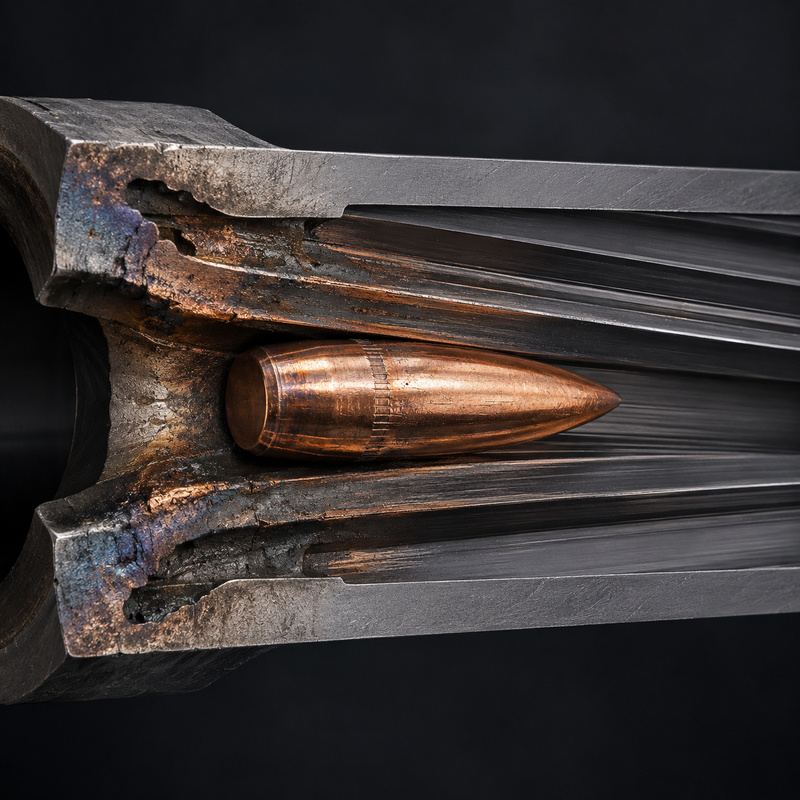
Barrel erosion , rifling wear , and bullet-bore friction are closely related, but not identical, phenomena. Their development depends on the high temperatures and pressures generated during firing, the action of the propellant gases, the flow of the bullet, and subsequent cleaning operations.
As shots are fired, these phenomena can progressively alter the internal surfaces of the barrel, influencing gas sealing, muzzle velocity, residue accumulation and, ultimately, the accuracy of the weapon.
What is cane erosion?
Erosion is the progressive loss or alteration of the material that forms the internal surface of the barrel. It occurs most frequently in the initial section immediately in front of the chamber, where temperature, pressure, and gas velocity reach particularly high values.
This area includes the forcing cone , also called the forcing cone, and the area where the projectile meets and engages the grooves. In rifled weapons, it is often referred to as the throat.
During firing, incandescent gases strike this surface before the projectile has begun to move significantly. The combined action of heat, pressure, and gas flow can produce:
- surface microcracks;
- thermal alterations of steel;
- rounding of the edges of the groove;
- small cavities and irregularities;
- progressive advancement of the starting point of the lines;
- greater ease of accumulation of residues.
Thermal erosion and gas action
A significant portion of wear results from the thermal action of the gases produced by the combustion of the gunpowder. For an extremely short period of time, the internal surface of the barrel is subjected to very high temperatures and intense mechanical stress.
Rapid heating of the surface layer, followed by cooling, generates repeated thermal cycles. As the number of impacts increases, microscopic cracks may appear, sometimes described as a surface appearance resembling dry, cracked earth.
The flow of high-pressure gases also contributes to erosion. Before the base of the bullet forms a complete seal, small amounts of gas can pass through the available spaces and directly impact the steel surface. This phenomenon is particularly severe in the initial section of the barrel.
What is rifling wear
Rifling consists of alternating helical grooves and cavities inside the barrel. When the bullet passes through the barrel, its jacket is incised by the rifling grooves and forced to rotate on its axis.
This rotation stabilizes the bullet during flight, but also produces contact pressure and friction on the internal surfaces of the barrel. With use, the edges of the solids can gradually lose their original geometry.
Wear and tear can appear through:
- rounding of the edges of the solids;
- local reduction of line depth;
- irregularity in the connecting cone;
- areas smoothed or, on the contrary, made rough by erosion;
- metallic deposits adhering to surfaces;
- progressive loss of uniformity along the barrel.
Wear does not necessarily develop uniformly. The initial section is generally subjected to the most intense thermal and pressure stresses, while the remaining section of the barrel is more affected by the flow of the bullet and debris.
Friction between bullet and barrel
The bullet normally has a diameter that engages the rifling and creates the necessary gas seal . As it passes through the barrel, the jacket deforms, adapting to the profile of the solids and voids.
The friction between the bullet and the barrel therefore arises from the contact between the jacket and the steel, from the pressure exerted by the bullet on the surfaces and from the resistance encountered in assuming the rotation imposed by the rifling pitch.
This friction performs two opposite functions:
- allows the rifling to transmit to the projectile the rotation necessary for stabilization;
- It absorbs part of the available energy and contributes to the wear of the surfaces.
The role of the bullet coat
In modern rifled ammunition, the bullet core is often coated with a jacket made of copper alloy, tombac, or other suitable material. The jacket protects the core, resists the stresses of firing, and interacts directly with the rifling.
The jacket's hardness, thickness, composition, and surface quality influence friction and material deposits in the barrel. An excessively hard or improperly sized bullet can increase stress, while one that is too soft can promote deformation and deposits.
Monolithic bullets made of copper or similar alloys exhibit different behavior than traditional lead-core and jacketed bullets. To reduce the effective contact surface, many monolithic bullets feature grooves or lightening bands along the body.
Metallic scale and deposits
During flow, small amounts of jacket material can adhere to the internal surfaces of the barrel. This phenomenon is commonly called copper plating or copper deposits.
Alongside metal deposits, the following may accumulate:
- carbon residues from combustion;
- particles from the trigger;
- bullet jacket material;
- traces of oil and products used for maintenance;
- residues left from previous cleaning operations.
A light deposit doesn't necessarily result in an immediate reduction in accuracy. However, when the fouling becomes irregular or excessive, it can locally alter the internal diameter, increase friction, and alter the bullet's behavior.
Factors that accelerate erosion
The useful life of a barrel depends on numerous factors and cannot be expressed with a single number of shots that applies to all weapons. Factors that can accelerate erosion include:
- high amount of powder compared to the barrel diameter;
- high combustion pressures and temperatures;
- particularly high-performance loads;
- rapid successions of shots with strong heating of the barrel;
- high-speed calibers and with large internal capacity;
- bullets with a large contact surface;
- cane materials and treatments;
- quality of maintenance;
- presence of corrosion or contaminants.
Cartridges informally referred to as overbore , characterised by a high case capacity in relation to the barrel cross-section, generally tend to concentrate a notable amount of thermal energy in the throat.
Heating the barrel
Heat accumulated during close-range firing can accelerate wear. A hot barrel is less able to absorb the energy of the next shot without reaching high surface temperatures.
This phenomenon is particularly relevant during prolonged shooting sessions, where the frequency of shots can be much higher than typical hunting use. Allowing the barrel to cool between series helps limit thermal stress and can slow the rate at which erosion develops.
Materials and surface treatments
Barrels can be made from different types of steel, including chromium-molybdenum steel and stainless steel. However, durability depends not only on the material name: composition, heat treatment, machining, internal finish, and conditions of use are equally important.
Some rods may receive treatments intended to improve surface hardness, corrosion resistance, or durability, such as:
- internal chrome plating;
- nitriding or equivalent thermo-chemical treatments;
- coatings developed for specific applications;
- lapping and accurate finishing of surfaces.
A well-finished internal surface may reduce the initial tendency for deposits to accumulate, but no material or treatment will completely eliminate the wear caused by use.
Running in the barrel
Barrel break-in is the subject of differing opinions among manufacturers, shooters, and gunsmiths. Some manufacturers recommend initial shooting and cleaning sequences, while others consider normal use and maintenance of the gun sufficient.
Any cleaning procedure should be performed only according to the manufacturer's instructions. Excessively aggressive cleaning can cause more problems than a controlled initial use.
Cleaning and mechanical wear
Cleaning removes carbon residue and metal deposits, but must be done with appropriate tools and products. Uncoated rods, worn brushes, improperly used abrasive compounds, or repeated passes through the muzzle can damage the rifling and, above all, the delicate geometry of the crown.
To limit the risks it is advisable to:
- follow the gun manufacturer's instructions;
- use a rigid, correctly sized wand;
- use a wand guide when possible;
- protect the muzzle crown;
- choose solvents compatible with steel and coatings;
- do not leave aggressive products in the barrel beyond the indicated time;
- avoid unnecessary abrasive procedures.
Signs of a worn rod
Wear cannot be accurately assessed by simply observing the accuracy of a single shot group. Possible signs include:
- progressive increase in dispersion;
- increased sensitivity to deposits;
- unusual variations in initial velocity;
- need to change the length of the cartridge to maintain the previous distance from the lines;
- appearance of visible irregularities in the throat;
- rounding or loss of definition of the ruling;
- reduction of consistency between successive shots.
However, the same symptoms can also depend on the optics, mounts, ammunition, stock, crown, or shooting technique. Therefore, the diagnosis must consider the entire weapon-ammunition system.
How to check barrel wear
A thorough inspection can be performed using a borescope , which allows observation of the fillet cone, the start of the rifling, and the surfaces along the barrel. The examination can reveal erosion, microcracks, corrosion, and copper or carbon buildup.
Other checks may include:
- throat advancement measurement;
- chronographic comparison with previous data;
- systematic verification of accuracy;
- muzzle crown control;
- evaluation using instruments by a qualified gunsmith.
The borescope image must be interpreted with experience: a surface that appears very marked at high magnification can still provide satisfactory accuracy.
Erosion and precision
A barrel doesn't necessarily lose accuracy suddenly. In most cases, the decline is gradual and can begin at the throat without producing any immediately noticeable effect on the target.
Accuracy may deteriorate when wear significantly alters:
- the entry of the bullet into the rifling;
- the symmetry of the pressures exerted on the mantle;
- gas tightness;
- the regularity of the initial velocity;
- the distribution of deposits;
- the exit of the projectile from the crown.
Pressure, velocity and friction
The friction exerted by the barrel is one of the resistances that the gases must overcome. Variations in internal conditions, due to deposits, lubricants, roughness, or differences between projectiles, can influence the development of pressure and velocity.
A completely degreased barrel, a slightly contaminated barrel, and a heavily copper-plated barrel can therefore produce different behaviors. For accuracy testing, it is important to maintain internal conditions that are as repeatable as possible.
The useful life of a rod
A barrel's service life does n't necessarily equate to its structural integrity. A barrel may still be safe but no longer offer the level of accuracy required for a particular discipline.
A competitive shooter might consider it worn out when the dispersion increases by just a few millimeters, while for hunting purposes, the same barrel can continue to provide adequate performance for a long time. Durability must therefore be evaluated in relation to the caliber, use, and required accuracy.
How to limit erosion and wear
Erosion cannot be eliminated, but it can be contained by adopting some precautions:
- use ammunition that conforms to the weapon's specifications;
- avoid shooting sequences that excessively overheat the barrel;
- let the gun cool between sets;
- perform regular but non-aggressive maintenance;
- properly remove moisture and corrosive substances;
- protect the throat and crown during cleaning;
- periodically check accuracy and internal conditions;
- Have the gun examined by a professional if there are any anomalies.
Three different but related phenomena
Barrel erosion is mainly due to the thermal and fluid-dynamic action of gases, rifling wear is caused by the progressive alteration of its geometry, while bullet-barrel friction arises from the contact necessary to ensure sealing and rotation.
These phenomena occur simultaneously and are inevitable in the normal operation of a firearm. However, barrel quality, ammunition characteristics, firing rate, and maintenance determine the speed at which they develop and the point at which they begin to affect performance.