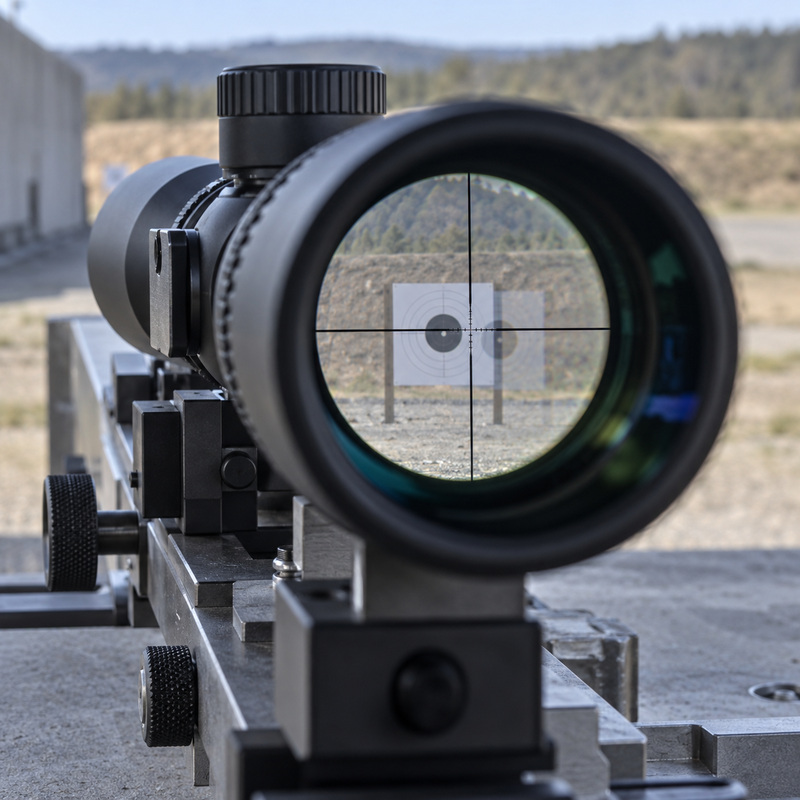
Parallax error occurs when the target image and the reticle of a riflescope are not on the same focal plane. If the eye changes position relative to the optical axis, the reticle appears to shift on the target even though the rifle and scope remain perfectly still. This apparent shift can translate into an actual error at the point of impact. This phenomenon becomes particularly significant at short distances, with high magnifications, on small targets, and whenever the head position is not maintained constant.
In short (Italian only)
- What is it: an apparent displacement between the reticle and the target.
- Why it happens: the image does not coincide with the grid plane.
- When it produces an error: when the eye moves with respect to the axis of the telescope.
- How to fix: by adjusting the parallax, when available.
- How to limit: maintaining constant cheek support and eye position.
How parallax arises
The objective of the telescope collects the light from the target and forms a real image inside the instrument. The reticle is placed in a mechanically defined position, corresponding to the first or second focal plane.
When the target is at the distance for which the system is adjusted, its image is formed exactly on the reticle plane. The two elements are optically integral and maintain the same relative position even if the eye moves slightly.
If the observed distance is different, the image can form in front of or behind the reticle. In this situation, a change in the eye's position alters the perspective between the two planes, making the reticle appear to move.
An example to understand it
The principle can be observed without using a telescope. Simply hold a finger in front of your eyes and align it with a distant object. By alternately closing your right and left eyes, the finger appears to move relative to the background.
The finger and the object are at different distances and are therefore observed from two slightly separate points. A similar phenomenon occurs in a telescope: the reticle represents the near-field plane, while the target image occupies a different optical plane.
When the two planes coincide, the shift in perspective disappears or is reduced to an imperceptible level.
Apparent movement and real error
Parallax is initially perceived as movement of the reticle, but it only produces an error in the shot if the eye is not centered in the same way as when zeroed in.
With the eye perfectly aligned with the optical axis, the shot can hit the intended target even when the parallax is incorrect. The problem arises when the head assumes a lateral, higher, or lower position.
The reticle still appears to point to the desired point, but the actual line of sight has changed. The error increases with distance from the optical center and the amount of separation between the planes.
Parallax and eye position
A repeatable head position reduces the effects of parallax, but does not eliminate its optical cause. The stock, cheekpiece, mount height, and eye relief should allow the eye to be naturally centered in the eyepiece.
If the shooter has to lift their face, rotate their head, or search for the image every time, they're more likely to be looking from different positions. This problem could be caused by a mount that's too high, an unsuitable stock, or an incorrectly adjusted eyepiece distance.
A stable cheek rest is therefore an essential part of the aiming system, together with the optic and its adjustment devices.
The exit pupil
The exit pupil is the small, bright disk visible behind the eyepiece. Its diameter is obtained by dividing the objective lens diameter by the magnification used.
As power increases, the exit pupil becomes smaller, forcing the eye into a more precise position. This can make centering easier, but it also makes any misalignment more obvious.
A large pupil offers greater freedom of movement, a useful feature for dynamic hunting. However, if the parallax is incorrect, that same freedom can allow the eye to move further without the image disappearing.
How to check parallax
The check must be carried out with the gun or scope completely still and pointed at a reliable reference. After sharpening the reticle using the diopter adjustment, the target is brought into focus.
Without touching the instrument, slowly move your head horizontally and vertically. If the reticle appears to slide across the observed surface, parallax is still present. When the reticle and target remain stationary relative to each other, the adjustment is correct.
A small amount of eye movement is sufficient. Excessive eye movement can cause the eye to move outside the exit pupil and create shadows that make the test less reliable.
Lateral parallax adjustment
Many riflescopes feature a side turret, often located on the left side of the main body. Rotating it changes the position of an internal optical group so that the target image is formed on the reticle plane.
The distances shown on the ring are approximate values. Manufacturing tolerances, atmospheric conditions, the user's visual characteristics, and magnification may cause the correct position to differ exactly from the indicated number.
The final adjustment must be made by observing the apparent movement of the reticle, not simply by setting the distance read with the rangefinder.
Adjustment on the lens
Some scopes use a ring around the objective lens, often referred to as an Adjustable Objective (AO) . Rotating the ring changes the position of the front lens assembly, allowing you to adjust the image plane to the observed distance.
This solution can offer precise adjustment, but requires reaching to the front of the scope and is less immediate from the shooting position. It is common in airgun optics, precision shooting, and relatively close-range applications.
Fixed parallax optics
Riflescopes without adjustment are factory-set for a specific distance. Depending on the manufacturer and market, hunting models may be zeroed in at around 100 meters or 100 yards. Air rifle and rimfire scopes can be adjusted for shorter distances.
Saying that a lens is "parallax-free" generally means that the phenomenon has been minimized at the pre-established distance. Outside that value, it may reappear, although within normal conditions of use the error may remain limited.
A fixed parallax scope is not necessarily inferior: it can be simple, lightweight, and perfectly suited to the distances for which it was designed.
Parallax and focus
Parallax adjustment can sharpen the target image by adjusting the group that determines its formation plane. However, sharpness and parallax absence are not synonymous.
The human eye has accommodation capabilities that can compensate for a small amount of blur. The target can therefore appear sharp even when it doesn't coincide perfectly with the reticle plane.
Checking by head movement remains the most reliable method of checking adjustment.
Parallax and diopter adjustment
The eyepiece diopter serves to sharpen the reticle in relation to the user's eyesight. It should be set by observing a uniform background, preventing the eye from trying to focus on a distant subject.
The side turret or AO dial, on the other hand, affects the target image. Using the diopter to correct a blurry scene alters the reticle's sharpness and can cause eye strain, but it does not eliminate parallax.
| Regulation | Affected element | Main function |
|---|---|---|
| Eyepiece diopter | Reticle | Adjusts sharpness to the user's vision |
| Lateral parallax | Target image | Bring the image to the grid plane |
| Adjustable lens | Front light unit | Corrects the image plane |
| Magnification ring | Zoom group | Change the apparent size of the scene |
How much can it affect the shot?
The amount of error depends on the telescope's construction, adjustment distance, magnification, and eye movement. Therefore, there is no universal value that applies to every instrument.
At moderate hunting distances and low magnification, the error of a properly designed optic can remain less than the overall dispersion of the weapon-ammunition system. On small targets and at long ranges, even a small angular deviation can become significant.
Parallax becomes particularly important when evaluating a rifle's accuracy, developing a reload, or verifying very tight groups. In these cases, it must be eliminated as a potential variable.
Why it is critical at short distances
A very close target can form an image significantly far from the plane to which the scope has been adjusted. For this reason, optics intended for compressed air, indoor shooting, or rimfire disciplines often have a correction starting at 10, 15, or 25 meters.
A hunting riflescope factory-calibrated for 100 meters may exhibit noticeable parallax when used on a target at very close range. The error is not due to the limited power of the rifle, but rather to the difference between actual range and the optical setting.
The role of magnification
At higher powers, the target and apparent reticle movement are more clearly visible. The smaller exit pupil also makes eye position more critical.
Magnification doesn't create parallax by itself, but it makes its effects more noticeable. By reducing the power, you can perceive less motion, without necessarily having the planes coincide again.
For accurate adjustment, it may be helpful to use high magnification, correct for the phenomenon, and then select the power best suited to the shot.
The optical mirage
Air turbulence can make the target appear to move or slightly distorted. This phenomenon, commonly called a mirage , should not be confused with parallax.
In a mirage, the image itself oscillates due to variations in air density along its path. In parallax, the reticle moves relative to the image as the eye changes position.
The two conditions can occur simultaneously and make regulation more difficult over long distances.
Ring shadow and centering
When the eye is not properly aligned, a crescent-shaped dark area may appear along the edge of the visual field. This ring-shaped shadow indicates that the gaze is not centered in the exit pupil.
By smoothing the shadow around the image, you improve the eye position. This method helps to make aiming more consistent, but it doesn't replace optical parallax adjustment.
If the reticle continues to move even when the image appears perfectly circular, the two planes do not yet coincide.
First and second focal plane
Parallax can affect both scopes with reticles in the first focal plane and models in the second focal plane. The position of the reticle determines the behavior of the graduations as the magnification varies, not whether they automatically coincide with the target image.
A properly graduated FFP reticle maintains its angular measurements at all powers, but may still exhibit parallax if the image is not focused in its plane. The same is true for an SFP reticle.
Influence on hunting activity
In driven hunts, characterised by low magnifications and generally limited distances, the problem is limited above all by correct shouldering and an optic adequately set at the factory.
In selective hunting, the ability to adjust parallax becomes more useful, especially when using high magnifications or shooting from a position that is not perfectly natural.
A lateral lean, a sharp incline, or the need to quickly assume an awkward posture can alter cheek contact and eye position. Optical correction reduces the system's sensitivity to these changes.
Adjustment procedure
- Adjust the diopter until you get an instantly sharp reticle.
- Stabilize the gun and scope on a secure support.
- Set the necessary magnification.
- Rotate the parallax control until the target is defined.
- Move your eye slightly without moving the instrument.
- Refine the adjustment until the crosshair no longer scrolls across the image.
- Check your head position and the circular view of the eyepiece again.
When the distance changes significantly, the check must be repeated. For hunting shots, however, it is essential to choose a quick, safe procedure that is compatible with the time actually available.
Mistakes and commonplaces
- “If the target is sharp, the parallax is correct.” The eye can compensate for a slight difference between the planes.
- “Error only exists at long distances.” It can be very noticeable even on nearby targets.
- “The value indicated on the bezel is always exact.” The scale represents an approximate reference.
- “An FFP scope is parallax-free.” The focal plane of the reticle does not eliminate the phenomenon.
- “The diopter also corrects the target.” Its main function is to adapt the reticle to the view.
How to recognize a quality system
The control must move smoothly and offer enough resistance to prevent accidental changes. Too much travel makes it difficult to make precise adjustments, especially at short distances.
The image should reach the correct focus in the same range in which the apparent movement of the reticle disappears. Marked differences may indicate incorrect diopter adjustment or a poorly calibrated optical system.
It's helpful to ensure that the point of impact doesn't change by adjusting the parallax. The control should change the image plane without introducing lateral or vertical shifts in the reticle.
Did You Know?
- Parallax can be present without producing an error if the eye remains perfectly on the optical axis.
- A correct adjustment does not necessarily coincide with the distance printed on the dial.
- At short distances the sensitivity of the control may be greater than that found between two distant values.
- This phenomenon can alter the evaluation of a shot pattern even when the gun and ammunition are extremely precise.
- The position of the cheek piece can affect the repeatability of your shot as much as some of the adjustments on your scope.
Final houghts
Parallax error arises from the mismatch between the reticle plane and the target image plane. It's not simply a blur, and it's not automatically eliminated by a seemingly sharp image.
Adjustment should be verified by observing the reticle's behavior as your eye slightly changes position. A properly adjusted scope, combined with a natural and repeatable cheek rest, reduces one of the most insidious variables in precision aiming.