PEEK is one of the most advanced engineering polymers available for mechanical, industrial , and technological applications. Its name derives from the English expression PolyEtherEtherKetone , in Italian polyether ether ketone.
This material combines mechanical strength, high temperature stability, low moisture absorption, and remarkable chemical resistance . In the hunting and firearms industries, it can be used to produce small precision components, bushings, guides, insulators, gaskets, and parts subjected to friction or harsh environmental conditions.
PEEK is no ordinary, low-cost plastic. It belongs to the category of high-performance thermoplastic polymers and is primarily intended for applications where materials like nylon, ABS, acetal, or polycarbonate do not provide sufficient stability.
What is PEEK?
PEEK is a semicrystalline thermoplastic polymer belonging to the polyaryletherketone family, often referred to by the acronym PAEK. Its molecular structure contains aromatic groups, ether bonds, and ketone groups, which are responsible for many of its properties.
The combination of these structures gives the material:
- high mechanical resistance;
- good rigidity;
- high temperature stability;
- wear and fatigue resistance;
- low moisture absorption;
- good electrical insulation properties;
- resistance to numerous chemicals.
As a thermoplastic, PEEK can be heated, processed, and transformed without requiring permanent cross-linking. However, processing requires much higher temperatures than those required for common engineering polymers.
The main properties of PEEK
The actual properties depend on the formulation, the degree of crystallinity, the presence of reinforcements, and the manufacturing process. A natural, unreinforced PEEK generally has a density of around 1,3 g/cm³ , significantly lower than that of metals.
The melting temperature is approximately 343°C , while the glass transition temperature is close to 143°C. Some grades can operate continuously at temperatures of the order of 250°C , provided that the conditions indicated by the manufacturer are respected.
These values should not be interpreted as universal limits. Loads, duration of exposure, friction, component geometry, and environmental conditions can significantly alter the material's behavior.
Mechanical resistance
PEEK offers high mechanical strength compared to many other polymers. It also maintains significant properties even when temperatures rise.
This property allows for the creation of lightweight and dimensionally stable components , especially when it is not necessary to achieve the rigidity of steel or a metal alloy.
Wear and friction resistance
PEEK has good tribological behavior, meaning it can withstand sliding, friction, and repeated contact . Specific formulations containing carbon fibers, graphite, or PTFE can further improve wear resistance and reduce the coefficient of friction.
For this reason, the material can be used for bushings, guides, washers, sealing rings and other parts where it is useful to avoid direct contact between metal components.
Chemical resistance
PEEK is resistant to numerous oils, greases, fuels, lubricants, detergents, and chemicals. This is important in components that may come into contact with gun oil, solvents, combustion residues, or maintenance products.
However, it is not completely impervious. Some very strong acids, certain oxidizing substances, and particularly aggressive conditions can damage it. Before using it, it is therefore necessary to check its compatibility with the specific chemical.
Low moisture absorption
Compared to materials like polyamide, PEEK absorbs relatively small amounts of water. This helps maintain its dimensional stability and mechanical properties even in humid environments.
This is an interesting feature for hunting gear, which is frequently exposed to rain, mud, condensation, snow and temperature changes.
PEEK in the arms industry
In the weapons industry, PEEK can be used to produce relatively small technical components . Its use is particularly interesting when lightness, dimensional precision, wear resistance, and thermal or electrical insulation are required.
Possible applications include:
- bushings and sliding supports;
- washers and spacers;
- guides for moving parts;
- sealing rings and gaskets;
- thermal or electrical insulators;
- supports for sensors and electronic components;
- parts intended for maintenance equipment;
- components of machinery used in the production of weapons and ammunition.
Not all of these features are necessarily present in every weapon. PEEK is chosen only when its characteristics offer a concrete advantage over less expensive engineering plastics or traditional metals.
Use in optics, viewers and electronic devices
Riflescopes, thermal imaging scopes, rangefinders, and electronic devices intended for outdoor use can be exposed to humidity, heat, vibration, and severe temperature changes. In these products, PEEK can be used to make:
- electrical insulators;
- connector supports;
- precision spacers;
- bushings and guides;
- internal housings;
- components near heat sources;
- details that must not interfere with electrical signals.
Its dimensional stability can help maintain proper component alignment. However, PEEK does not automatically replace aluminum, steel, or magnesium in external structures, where different stiffness and impact resistance may be required.
Natural PEEK and reinforced PEEK
PEEK is marketed in numerous formulations. The choice should therefore not be based solely on the polymer name, but on the specific grade and its certified properties.
Unreinforced PEEK
Natural PEEK offers a good balance of strength, toughness, machinability, and electrical insulation. It can be used for gaskets, insulators, spacers, and precision components.
Glass-fiber reinforced PEEK
The addition of glass fiber generally increases stiffness, dimensional stability, and resistance to deformation under load . However, the material becomes less ductile and can be more abrasive to tools and surfaces it comes into contact with.
Carbon fiber reinforced PEEK
Carbon fibers can increase stiffness, strength, and dimensional stability while simultaneously reducing thermal expansion. These formulations are suitable for lightweight structural components and special applications subjected to high stresses.
Carbon fiber-filled PEEK should not be confused with a traditional continuous fiber composite . In moldable or processable grades, the fibers can be short and distributed throughout the polymer matrix.
PEEK for tribological applications
Some formulations contain graphite, carbon fiber, or PTFE to improve frictional behavior. These materials are primarily used for bushings, bearings, guides, and sliding components.
How PEEK is processed
PEEK can be transformed through different industrial technologies:
- injection molding;
- extrusion;
- compression molding;
- solid mechanical processing;
- additive manufacturing;
- production of films and coatings.
Semi-finished bars, sheets, and tubes can be machined with CNC machines to produce precision components. During machining, it's important to monitor clamping, temperature, tool geometry, and internal stresses in the material.
Molding requires equipment capable of reaching high temperatures. 3D printing with PEEK is also more complex than that of PLA, ABS, or nylon and requires extruders, heated chambers, and appropriate control systems.
Advantages of PEEK
- High temperature resistance: maintains its characteristics under conditions where many polymers soften.
- High mechanical strength: allows the production of robust components with low weight.
- Good dimensional stability: useful for precision work.
- Low moisture absorption: limits dimensional variations in humid environments.
- Chemical resistance: withstands contact with numerous oils, greases and industrial substances.
- Wear resistance: fits bushings, guides and sliding surfaces.
- Electrical insulation: interesting for optics, viewers and electronic devices.
- Low weight: the density is much lower than that of steel, brass and aluminum.
- Machinability: It can be printed or machined.
Limitations of PEEK
The main limitation of PEEK is its high cost . Raw materials, processing temperatures, tooling, and process control make the components more expensive than those made with conventional polymers.
- It doesn't always replace metal: Steel and light alloys can offer greater stiffness, hardness or impact resistance.
- Requires high processing temperatures: the systems must be specifically equipped.
- It can be difficult to glue: the surface has a low predisposition to adhesion and may require specific treatments.
- Reinforced grades are abrasive: Glass and carbon fibers can increase tool wear.
- Planning is key: Fiber orientation, thicknesses, and fillet radii influence performance.
- It's not indestructible: Impacts, excessive loads or incompatible substances can cause deformations or breakages.
PEEK, nylon, and acetal: what are the differences?
Nylon is inexpensive, tough, and widely used in accessories and technical components. However, it absorbs more moisture and is more susceptible to dimensional changes. PEEK generally offers better thermal and chemical stability, but is significantly more expensive.
Acetal, also known as POM, features good dimensional accuracy, low friction, and favorable machinability. It is well-suited for gears, levers, guides, and bushings, but does not match the thermal performance of PEEK.
PEEK is therefore chosen when temperature, stress, chemical aggression or precision make the most common technopolymers insufficient.
PEEK and carbon fiber
PEEK and carbon fiber are not alternative materials in the strictest sense. PEEK can, in fact, form the matrix of a carbon fiber-reinforced composite material .
The result combines the thermal and chemical properties of the polymer with the stiffness of the reinforcement. Performance, however, depends on the percentage, length, and orientation of the fibers, as well as the quality of the manufacturing process.
A component molded with short fibers exhibits different behavior than a laminate made of continuous fibers impregnated with PEEK matrix.
Can PEEK be used for stocks and grips?
Technically, PEEK can be molded into complex shapes, but its cost generally makes it unsuitable for making entire stocks, forends, or grips . Reinforced polyamides, cheaper polymers, traditional composites, wood, or carbon fiber are generally preferred for these components.
PEEK is best suited for small parts subjected to heat, friction, chemical agents or high stress, where the quantity of material used is small and the technical advantage can compensate for the cost.
How to recognize a PEEK component
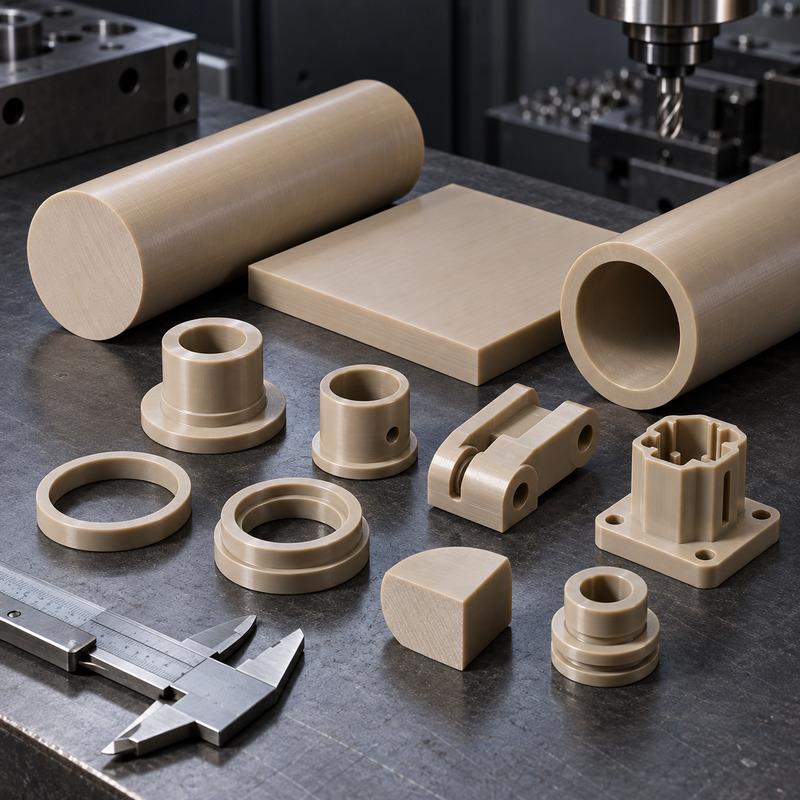
Natural PEEK generally has a color ranging from beige to light brown . Filled formulations can be black, gray, or other shades.
However, color doesn't allow for definitive identification of the material. Many polymers can have a similar appearance, and some components may be colored or coated.
For correct identification it is necessary to consult:
- manufacturer's technical data sheet;
- material code;
- percentage and type of reinforcement;
- maximum declared temperature;
- certified mechanical properties;
- chemical compatibility;
- component production method.
Frequently Asked Questions about PEEK
Is PEEK stronger than steel?
No. PEEK is very strong compared to other polymers and offers a favorable performance-to-weight ratio, but it does not have the rigidity, hardness, and absolute strength of major steels.
Is PEEK resistant to gun oil?
It generally has good resistance to numerous oils, greases, and lubricants. Compatibility must, however, be verified with the specific product's chemical formulation.
Does PEEK absorb water?
It can absorb a limited amount of moisture, but less than other polyamides. This promotes dimensional stability in humid environments.
Can PEEK be 3D printed?
Yes, but it requires professional printers capable of reaching high temperatures and carefully controlling cooling. Improper printing can cause warping, poor adhesion between layers, and lower-than-expected properties.
Does PEEK withstand the heat of the barrel?
The material has high thermal resistance for a polymer, but its suitability depends on the temperature reached, the distance from the flue, the duration of exposure, and the applied load. It should not be placed near very hot areas without specific design considerations.
Is PEEK always better than other polymers?
No. In many applications, nylon, POM, polycarbonate, or reinforced polymers provide sufficient performance at a lower cost. PEEK is especially advantageous when operating conditions truly require its superior properties.
Conclusions
PEEK is a high-performance technopolymer capable of combining lightness, mechanical strength, thermal stability, dimensional precision and chemical resistance.
In the world of weapons, optics and hunting equipment it finds application above all in precision technical components: bushings, guides, gaskets, spacers, insulators and supports intended to work in difficult conditions.
Its high cost limits its use to cases where a conventional polymer would not be sufficiently reliable. However, the mere presence of the PEEK acronym does not define the component's performance: it is necessary to know the formulation, reinforcement, production process, and conditions of use.