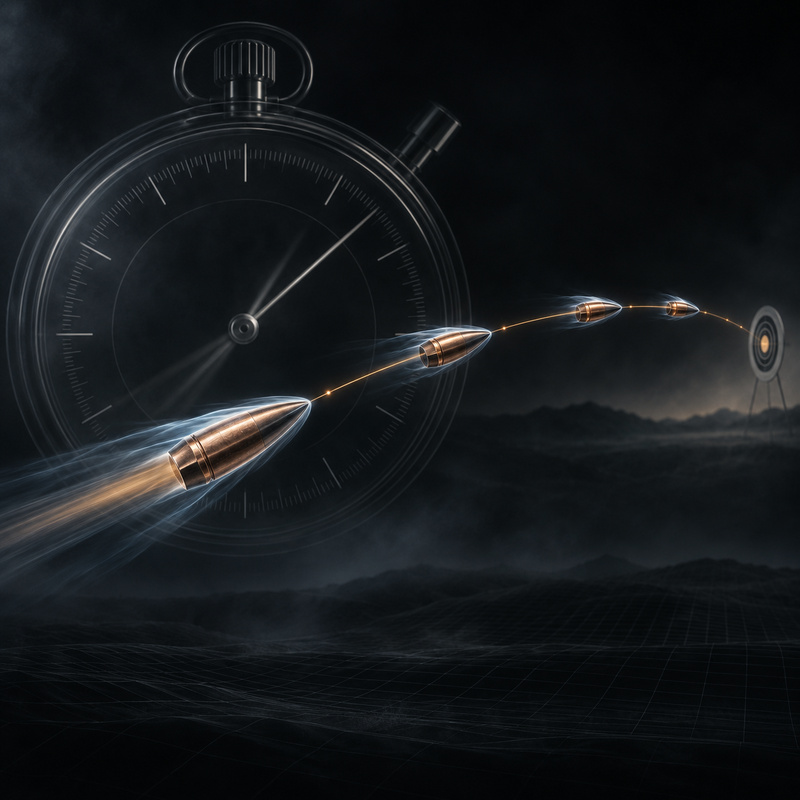
Time of flight , often referred to as TOF , is the interval between the bullet leaving the muzzle and its arrival on the target or at a specific point on its trajectory.
This value is fundamental in external ballistics because it determines how long the projectile remains subjected to gravity, air resistance, wind and other phenomena that alter its path.
A shorter flight time generally results in less drop, less wind drift, and a reduction in the amount of travel a moving target can make before the projectile arrives.
Why flight time is not calculated using initial velocity alone
In the absence of atmospheric resistance, the time of flight could be calculated by dividing the distance by a constant velocity. In the real world, however, the bullet begins to lose velocity immediately after exiting the barrel.
The simplified relationship:
Time = distance ÷ speed
It only provides a reliable result if the average speed over the entire course is used , not just the sprint speed.
Using the initial velocity as if it remained constant leads to underestimating the actual time, especially at long distances.
Initial velocity and average velocity
The initial velocity is the velocity possessed by the projectile near the muzzle. The average velocity is the average value maintained over the distance considered.
Because air resistance progressively slows the projectile, the average velocity is always lower than the initial velocity. The difference depends mainly on the ballistic coefficient, the shape of the projectile, and the atmospheric density.
Two projectiles launched at the same velocity can therefore reach the same target in different times if they have different ballistic coefficients.
The role of the ballistic coefficient
The ballistic coefficient (BC) describes a projectile's ability to maintain velocity during flight. A projectile with a high BC decelerates more slowly and tends to reach its target more quickly than a less efficient projectile, given the same muzzle velocity and range.
The advantage of a high coefficient becomes progressively more evident as the distance increases. In the first few meters, it may be modest, but at long distances, it can produce significant differences in flight time.
Time of flight and gravitational fall
Gravity acts on the projectile throughout its flight. The longer it spends in the air, the greater the vertical displacement produced by gravity.
In the ideal model with no aerodynamic drag, the drop from the initial line can be expressed through the relationship:
Fall = ½ × g × t²
Where:
- g it is the acceleration of gravity;
- t it's flight time.
Time is squared, meaning that increasing it produces an even faster increase in velocity than falling. Air resistance, barrel tilt, line of sight, and atmospheric conditions must also be considered in the actual calculation.
The trajectory does not depend only on the distance
Two bullets traveling the same distance may have different drop rates because they take different times to reach the target.
Flight time depends on:
- initial velocity;
- ballistic coefficient;
- G1, G7 or custom resistance model;
- shape and mass of the projectile;
- air density;
- residual speed;
- corner of the site;
- supersonic, transonic or subsonic regime;
- wind with a frontal or rear component.
Flight time and wind drift
Crosswinds alter the projectile's trajectory throughout its flight. A longer flight time gives the wind a greater chance of causing lateral displacement.
Drift isn't simply calculated by multiplying wind speed by flight time. The projectile isn't entirely transported at the same speed as the air, but reacts to aerodynamic forces based on its velocity, shape, and stability.
Flight time remains one of the main factors: a fast-moving bullet with a high BC tends to drift less because it travels the distance faster.
Headwind and tailwind
A frontal wind component increases the relative velocity of the air encountered by the projectile and can increase its deceleration. A rearward wind component, on the other hand, can slightly reduce relative drag.
The effects on flight time are normally less noticeable than those produced by a strong crosswind on the fin, but can become significant at long ranges and in precision calculations.
Flight time and moving targets
When the target is moving, it continues to move for the time it takes the projectile to reach it. The distance traveled by the target depends on its speed, direction, and flight time.
In simplified form:
Target displacement = lateral velocity × flight time
The actual evaluation must also consider the angle at which the target crosses the firing line. A perfectly lateral movement produces the maximum apparent displacement, while a movement directed toward or away from the shooter has a lower lateral component.
In hunting, uncertainty about the animal's speed and direction makes these shots particularly complex. The priority must remain a prudent and responsible assessment of the conditions.
Flight time and residual speed
The time required to cover a given distance depends on the velocity maintained throughout the entire journey. A projectile that maintains velocity better has a higher average velocity and a shorter flight time.
Residual speed also influences:
- kinetic energy at the target;
- how the expanding projectile works;
- stability in the transonic region;
- sensitivity to wind;
- curvature of the trajectory.
The transonic passage
As the projectile slows down and approaches the speed of sound, it enters the transonic region . At this stage, the aerodynamic pressure distribution changes rapidly, and drag can increase or vary in complex ways.
Deceleration in the transonic region affects time of flight and can highlight any dynamic stability issues. Projectiles designed for long ranges attempt to navigate this phase while maintaining smooth behavior.
A single average ballistic coefficient may not perfectly describe the bullet across all velocity regimes.
Condizioni atmosferiche
Air density directly affects deceleration. In denser air, the projectile encounters greater resistance, loses velocity more rapidly, and takes longer to reach its target.
Atmospheric density depends mainly on:
- pressure;
- temperature;
- umidità;
- altitude.
Higher temperatures, lower pressures, and higher altitudes generally reduce air density. Under these conditions, the projectile retains its velocity better, and flight time can be shorter than in cold, dense air.
Altitude and flight time
At high altitudes, atmospheric pressure is typically lower and the air less dense. The projectile therefore encounters less resistance and maintains a higher velocity along its trajectory.
Given the same weapon, ammunition, and distance, flight time may be slightly shorter than that observed at sea level. The difference increases with distance.
To obtain reliable calculations it is preferable to use the actual atmospheric pressure at the shooting location or the density-altitude calculated by a meteorological instrument.
Ammunition temperature
Ammunition temperature can affect muzzle velocity because it alters the propellant's behavior. The effect varies depending on the type of powder and the cartridge's construction.
A change in muzzle velocity affects the time of flight and, consequently, the drop and drift. For precision applications, it's best to avoid exposing cartridges to temperatures significantly different from those used for ballistic data verification.
Site angle and flight time
When shooting up or down, the distance measured along the line of sight does not coincide with its horizontal component. The angle changes the geometry of the trajectory and the way gravity acts on the aiming line.
The time of flight, however, depends on the distance actually traveled by the projectile and the velocity maintained along that path. The simple cosine rule can be useful for estimating the horizontal component, but it is no substitute for a complete ballistics calculation.
The effect of the Earth's rotation
When shooting at very long distances, the Earth's rotation can also produce an apparent shift in trajectory, known as the Coriolis effect.
The amount of displacement increases with flight time and is influenced by:
- latitude;
- direction of shot;
- distance;
- projectile velocity;
- flight duration.
At normal hunting distances the effect is generally negligible, while it can be considered in specialist shooting at very long ranges.
Gyroscopic drift and flight duration
The rotation imparted by the rifling can generate a small lateral deviation called gyroscopic drift or spin drift. This effect tends to increase with distance and the length of time the bullet remains in flight.
With right-handed rifling, the drift normally occurs to the right; with left-handed rifling, to the left. This phenomenon is also particularly significant at long ranges.
How to calculate flight time
For a rough estimate, you can divide the distance by the average speed. However, the average speed is usually unknown without first calculating the deceleration.
Ballistic calculators divide the trajectory into very small intervals and progressively determine:
- residual speed;
- aerodynamic resistance;
- time elapsed;
- vertical and lateral position;
- speed regime;
- effects of atmospheric conditions.
The sum of the small time intervals gives the total time needed to reach the set distance.
The data needed for the calculation
To obtain a reliable flight time, correct data must be entered relating to:
- measured initial velocity;
- ballistic coefficient and related model;
- bullet characteristics;
- real distance;
- atmospheric temperature;
- pressure;
- umidità;
- altitude or density-altitude;
- corner of the site;
- any longitudinal components of the wind.
An error in muzzle velocity or ballistic coefficient can produce increasing differences at long ranges.
Declared speed and real speed
The velocity indicated by the ammunition manufacturer is obtained with a specific test barrel and under controlled conditions. The shooter's firearm may produce a different value.
Actual speed depends on:
- barrel length;
- actual dimensions of the chamber and core;
- ammunition lot;
- cartridge temperature;
- internal conditions of the barrel;
- manufacturing tolerances.
To correctly calculate the flight time it is preferable to use an average speed measured with a chronograph on the specific weapon.
Direct measurement of time of flight
Time of flight can be measured using specialized instruments, including Doppler radar, synchronized acoustic systems, and high-speed equipment.
Doppler radar allows the projectile to be tracked along its trajectory and its velocity to be detected at numerous points. From this data, it is possible to directly calculate the elapsed time and evaluate the actual deceleration.
Experimental measurements are particularly useful for verifying ballistic coefficients and customized drag curves.
Flight time and impact sound
At long ranges, a delay may be noticeable between the shot and the impact. This delay is not the mere flight time of the projectile.
The delay perceived by the shooter includes:
- time taken by the projectile to reach the target;
- time required for the sound of impact to return to the firing point.
Because the bullet can initially travel at supersonic speed, it reaches its target before the sound of the shot can reach the same point. The sound of the impact must then travel the distance in the opposite direction.
Flight time and zeroing distance
Zeroing distance doesn't directly affect the bullet's velocity or time of flight. However, it does change the geometric relationship between the aiming line and the trajectory.
A calculator uses the time of flight to determine the physical drop and then translates this drop into the necessary correction from the set zero.
Two weapons with the same velocity and ammunition, but zeroed at different ranges, can have the same time of flight to a target, even though they require different vertical corrections.
Flight time and accuracy
A short flight time does not automatically make a round more accurate. Accuracy depends on the consistency of the gun, the barrel, the ammunition, and the stability of the projectile.
However, a higher velocity and a high BC can reduce the effect of errors in assessing wind and target motion. This makes the ballistic solution less sensitive to certain external variables.
Importance in hunting use
At most normal hunting distances, flight time is very short. It becomes more important as the distance, wind, or the possibility of the animal moving after the shot increases.
A short flight time doesn't eliminate the unpredictability of animal behavior. Even in a few tenths of a second, an animal can change position. Therefore, shot selection must take into account distance, stability of position, and the likelihood of a prompt and responsible outcome.
Flight time in smoothbore weapons
Even pellets and slugs fired from a smoothbore barrel have their own flight time. Pellets, due to their spherical shape and very low ballistic coefficient, lose velocity rapidly.
Smaller pellets have a less favorable mass-to-surface area ratio and slow down more quickly. Larger pellets generally retain velocity and energy better.
When evaluating shots at moving game, the flight time of the shot pattern contributes to determining lead, along with the speed, direction and distance of the target.
Smoothbore bullet flight time
Unique smoothbore shotgun bullets have different aerodynamic characteristics than tapered rifle bullets. Their generally lower ballistic coefficient results in a relatively rapid loss of velocity.
As distance increases, flight time, drop, and wind sensitivity increase. The data must be verified for the specific combination of gun, barrel, and cartridge.
Common errors in evaluation
Some of the most common errors include:
- divide the distance by the muzzle velocity alone;
- consider the constant velocity along the trajectory;
- use a ballistic coefficient without specifying G1 or G7;
- enter only a declared speed into the calculator;
- ignore the weather conditions;
- confusing bullet timing with impact sound delay;
- neglect the transonic passage;
- use data referring to a different ammunition.
A parameter that links speed, fall and wind
Time of flight connects numerous phenomena in external ballistics. It determines the duration of gravity's action, influences wind drift, and establishes how far a target can move before the projectile arrives.
High muzzle velocity and a good ballistic coefficient help reduce it, but the actual value depends on the overall deceleration along the trajectory. To obtain reliable predictions, it is necessary to use measured data, an appropriate aerodynamic model, and atmospheric conditions representative of the shooting location.