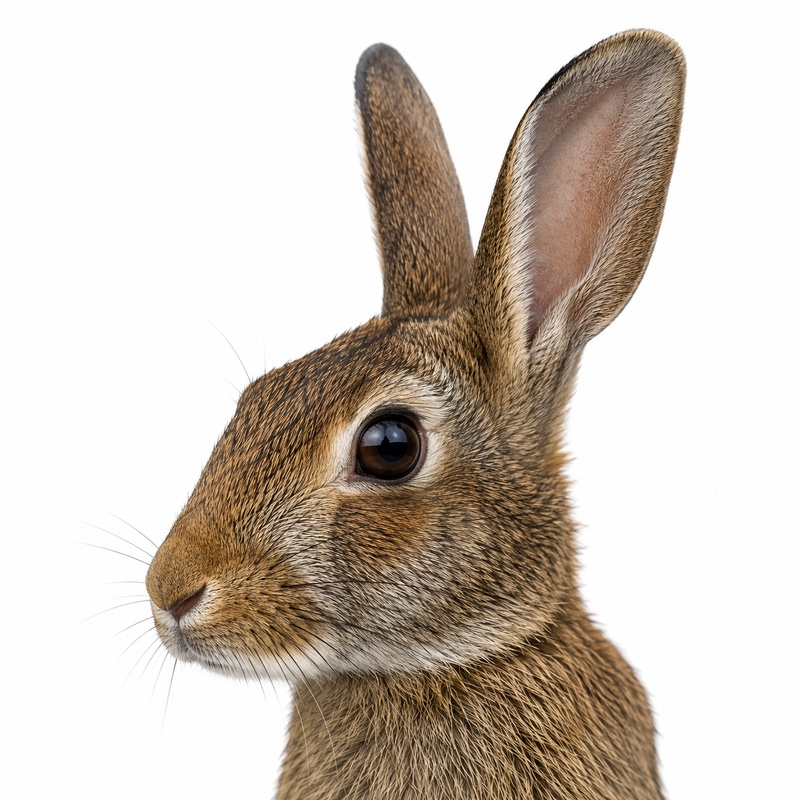
The wild rabbit , scientifically Oryctolagus cuniculus , is one of the world's best-known and most widespread lagomorphs and represents a species of extraordinary interest from a naturalistic, historical, and hunting perspective. Smaller and more compact than hares, it often lives in organized colonies around complex systems of underground burrows and has an extremely high reproductive capacity, allowing it to rapidly increase its population when the environment offers favorable conditions.
Its history is deeply intertwined with that of man. Originally from the Iberian Peninsula , the wild rabbit was transported and introduced to numerous regions of the Mediterranean, Europe, and subsequently the rest of the world. In Italy, it is present primarily in many central and southern regions and on islands, with particularly large populations in Sardinia, Sicily, and numerous smaller islands.
From a hunting perspective, it is a game animal profoundly different from the hare. It does not normally spend the day in a simple open lair on the ground, but uses burrows and underground tunnels . When disturbed, it tends to make relatively short, rapid escapes, attempting to reach the nearest shelter. This characteristic has favored the development of extremely specialized hunting methods, which can utilize hunting dogs, terriers, dachshunds, and other assistants capable of working through the most tangled vegetation.

Wild rabbit: identity card
| Common name | Wild rabbit |
| Scientific name | Oryctolagus cuniculus |
| Class | Mammalia |
| Order | Lagomorpha |
| Family | Leporidae |
| Gender | Oryctolagus |
| Origin | Iberian Peninsula and Western Mediterranean area |
| Head-body length | Approximately 34-50 cm |
| adult weight | Generally around 1-2,5 kg |
| Length of the ears | Approximately 6,5-7,5 cm |
| Main habitat | Meadows, pastures, Mediterranean scrub, shrublands, dunes, agricultural land and environments with soils suitable for excavation |
| Supply | Herbivorous |
| Activities | Mainly crepuscular and nocturnal |
| Rifugio | Burrows and underground tunnel systems |
| Social behavior | Gregarious, organized in groups and colonies |
| Playback | High reproductive capacity, with multiple births during the year |
| Gestation | Approximately 28-31 days |
| Little ones | Generally 3-6 per birth, with variations |
| Hunting status in Italy | Huntable species according to national regulations and regional calendars |
How to recognize a wild rabbit
The wild rabbit has a compact and compact structure, very different from the slender silhouette of the hare.
The body is relatively short, the hind legs are longer than the front ones but much less developed than those of Lepus , while the ears are shorter than the length of the head.
These characteristics generally allow it to be easily distinguished from a European hare even when observed from a distance.
The Wild Rabbit's Coat
The typical coloration is that defined as agouti , characterized by a complex mixture of brown, greyish, reddish and black shades.
The back and sides can vary from reddish-brown to greyish-brown depending on the season, individual and population.
The underparts are generally lighter, while the nape may have a characteristic reddish hue.
The Wild Rabbit's Tail
The tail is short and has a sharply contrasting coloration.
The upper part shows a darker band, while the lower part is light or white.
When the rabbit runs it tends to raise its tail, making the white surface very visible.
The ears
The ears are relatively short compared to those of hares and are one of the easiest features to use for recognition.
The apex may be bordered by a thin dark line, but generally does not have the large, clear black spot typical of many species of the genus Lepus.
The eyes
The eyes are placed laterally and ensure a wide field of vision.
Lateral vision is very developed, while frontal binocular vision is more limited.
This configuration is particularly useful for a small herbivore exposed to predation and forced to constantly monitor what is happening in the surrounding environment.
The Wild Rabbit's Sense of Smell
The sense of smell is highly developed and plays a fundamental role both in identifying danger and in communication between individuals.
Rabbits use odor signals to recognize conspecifics, delimit frequented areas, and orient themselves within the colony.
Hearing
Hearing is also extremely efficient.
Movable ears allow the animal to quickly locate sounds coming from different directions and enable it to react very quickly when it perceives a threat.
Wild Rabbit and European Hare: What Are the Differences?
| Feature | Wild rabbit | European hare |
|---|---|---|
| Scientific name | Oryctolagus cuniculus | Lepus europaeus |
| Size | Smaller and more compact | Bigger and slimmer |
| Ears | Shorter | Very long |
| Hind legs | Relatively short | Very long and powerful |
| Rifugio | Underground lairs | Surface lair |
| Social behavior | Gregarious | Generally more solitary |
| Small at birth | Naked, blind and dependent | Covered in fur, eyes open and mobile |
| Escape strategy | Quick run to the den | Prolonged escape at high speed |
| Playback | Very high | Less explosive |
The fundamental difference: the den
The most important distinction between rabbits and hares concerns the way they approach rest and reproduction.
The hare normally uses a surface burrow on the ground. The wild rabbit, on the other hand, digs actual underground burrows.
This difference has profoundly influenced the anatomy, social behavior, reproduction and defense strategies of the two species.
Origin of the Wild Rabbit
The native range of Oryctolagus cuniculus is mainly located in the Iberian Peninsula and the western Mediterranean area.
Throughout history, humans have played a fundamental role in the spread of the species.
Already in ancient times the rabbit was transported to numerous European islands and territories, beginning a process of expansion that would continue for centuries.
The role of the Romans in the spread of the rabbit
The spread in the Mediterranean area is often also linked to human activities in the Roman era.
The rabbits were kept in dedicated facilities and used as a food resource.
Gradually the species was introduced into numerous regions where it was not naturally present.
The rabbit and domestication
The domestic rabbit derives from Oryctolagus cuniculus.
Through centuries of artificial selection, breeds have been created that are characterized by size, color, conformation, and behavior very different from the wild form.
Despite this, domestic and wild rabbits belong to the same species and can interbreed.
Domestic Rabbits and Wild Rabbits: What Are the Differences?
The wild rabbit generally has a more athletic build and a much more cautious and reactive behavior.
Natural selection has favored developed senses, rapid escape, the ability to dig, and a keen awareness of predators.
Domestic breeds, on the other hand, may present morphological and behavioral characteristics that have been profoundly modified by man.
Worldwide distribution
Today the wild rabbit is present in many regions of the world.
Human introductions have brought it to:
most of Europe;
numerous Mediterranean islands;
Australia;
New Zeland;
South America;
numerous oceanic islands.
In some areas it has become extremely abundant and can represent a problematic species from an ecological and agricultural point of view.
The Wild Rabbit in Italy
The Italian distribution is strongly influenced by historical introductions.
The species is particularly well represented in the Mediterranean regions and on the islands , where the climate, vegetation and soil characteristics can be very favourable.
Sardinia and Sicily are home to significant populations, but the rabbit is also present in numerous other areas of the Peninsula and on many smaller islands.
The Wild Rabbit in Sardinia
Sardinia is one of the Italian regions where the wild rabbit has a particularly deep-rooted presence in the fauna and hunting tradition.
Mediterranean scrub, pastures, bushes and easily excavated soils can offer ideal conditions for the formation of colonies.
The Wild Rabbit in Sicily
Sicily is also home to significant populations of wild rabbits.
The species can frequent agricultural areas, scrubland, arid lands and numerous coastal environments etc.ollinari.
Very dark or almost black color variants have also been documented locally.
The Wild Rabbit in the Smaller Islands
Numerous Italian islands have hosted or host introduced rabbit populations.
In island environments, its impact can become particularly significant because the high density can modify the vegetation and affect other species present.
Wild Rabbit Habitat
The wild rabbit prefers environments in which both herbaceous vegetation for feeding and areas suitable for digging burrows are present.
Soils that are too compact, completely rocky, or frequently flooded are generally less suitable for the construction of complex underground systems.
The Wild Rabbit's Favorite Environments
| Grasslands with bushy areas | ★ ★ ★ ★ ★ |
| Open Mediterranean scrub | ★ ★ ★ ★ ★ |
| Pastures | ★ ★ ★ ★ ★ |
| Sandy soils | ★ ★ ★ ★ ★ |
| Dunes and coastal environments | ★★★★ ☆ |
| Uncultivated | ★ ★ ★ ★ ★ |
| Diversified crops | ★★★★ ☆ |
| Bushes | ★ ★ ★ ★ ★ |
| Very closed woods | ★★☆☆☆ |
| Frequently flooded land | ★☆☆☆☆ |
Why is soil so important?
The ability to burrow is one of the fundamental elements in choosing a habitat.
Sandy, clayey but sufficiently drained soils and easily workable land allow the construction of tunnels and underground chambers.
However, the stability of the ground must be sufficient to avoid the continuous collapse of the tunnels.
The Wild Rabbit's Den
The den can be much more complex than it appears by simply looking at the entrance.
Mature colonies can construct veritable underground systems consisting of numerous tunnels, chambers, and openings.
These structures offer protection from predators, heat, cold, and adverse weather conditions.
The rabbit hutch
A burrow system occupied by numerous individuals is often referred to as a rabbit warren.
It may have several entrances connected to a complex underground network.
The structure can be used for many generations and progressively expanded by animals.
The entrances to the den
Having multiple entries represents an important defensive advantage.
An animal sensing a threat can quickly reach the nearest opening and disappear underground.
The different exits also make it more difficult for a predator to completely control the structure.
Does the rabbit always live underground?
No. The den represents above all a refuge and a fundamental place for reproduction.
However, the animal spends many hours outside to feed, especially during the twilight and night hours.
Individuals may also use simple surface shelters when environmental conditions permit.
A social animal
Unlike hares, the wild rabbit has a strong tendency towards social life.
Multiple individuals may share the same burrow system and form organized groups.
Within the colony, relatively complex hierarchies and social relationships can develop.
The hierarchy in the colony
Males and females can organize themselves into hierarchical relationships that influence access to resources, resting areas, and reproductive opportunities.
Dominant individuals generally tend to occupy the best areas of the hutch.
How does the wild rabbit communicate?
Communication uses different channels:
odors;
postures;
body contact;
sound signals;
territory markings.
The sense of smell plays a particularly important role in social life.
The hind leg kick
When it detects danger, the rabbit can violently strike the ground with its hind legs.
The vibration produced acts as an alarm signal for other individuals in the vicinity.
It is one of the most characteristic behaviors of the species.
When is the Wild Rabbit active?
The activity is mainly crepuscular and nocturnal.
Animals tend to emerge from their burrows around dusk and use the hours of lower light to feed.
In less disturbed areas, however, they can also be observed during the day, especially in the cooler hours.
The distance from the den
Rabbits generally tend not to stray too far from their shelters.
The ability to quickly reach a den is in fact one of the fundamental elements of the survival strategy.
The distance can of course increase when food resources are distributed further away.
The Wild Rabbit's Escape
When surprised, the rabbit takes off with a very rapid acceleration.
The escape often involves continuous changes of direction and is generally directed towards a den or an area of very dense vegetation.
The strategy is therefore very different from that of the hare, which can sustain a chase at a much greater distance.
Why does the Wild Rabbit run in a zigzag pattern?
Sudden changes in direction can make it more difficult for a predator to catch them.
The compact structure allows the animal to quickly change trajectory and reach the entrance of the den before the pursuer can get close.
How far can a wild rabbit run?
The wild rabbit can reach high speeds over short distances, but does not possess the same sustained running ability as large hares.
His strategy is based mainly on the combination of acceleration, agility and proximity to the shelter.
Wild Rabbit Feeding
The wild rabbit is a herbivore and uses a wide variety of plant resources.
The diet changes according to the season, environment and local availability.
What does the wild rabbit eat?
The diet may include:
grasses;
wild herbs;
sprouts;
leaves;
legumes;
cereals;
roots and underground parts;
bark and twigs in times of scarcity.
The Wild Rabbit and the Pastures
Pastures represent particularly favorable environments when there are areas nearby suitable for building dens.
Short, young grass can provide easily accessible, high-quality nutritional food.
The Wild Rabbit and Agriculture
Cropland and forage crops can be a very important resource.
When densities become particularly high, however, the rabbit can cause damage to crops , especially in areas close to the colonies.
Cecotrophy
Like other lagomorphs, the wild rabbit also practices cecotrophy.
During digestion, particular soft excrements are produced, rich in nutrients and microorganisms, which are ingested directly by the animal.
This process allows for the extremely efficient use of a high-fiber, plant-based diet.
Reproduction of the Wild Rabbit
The extraordinary reproductive capacity represents one of the best known characteristics of the species.
When climate and food availability are favorable, a female can produce multiple litters in the same year.
This characteristic allows populations to increase rapidly after favorable periods or to recover after phases of high mortality.
When does the wild rabbit breed?
The breeding season varies significantly with the climate.
In Mediterranean regions it can last for many months, while in areas with harsher winters it tends to be concentrated mainly between late winter, spring and summer.
The availability of fresh vegetation is one of the main factors influencing reproductive activity.
How long is gestation?
Gestation is very short and generally lasts about 28-31 days.
This rapidity contributes greatly to the population growth potential.
How many pups are born?
A litter generally consists of 3-6 pups , although the number can vary.
Adult females in good condition can produce multiple litters during the same season.
The little wild rabbits
Unlike leverets, baby rabbits are born naked, blind and completely dependent on their mother.
The ability to give birth inside a protected den allows for this reproductive strategy.
It is one of the fundamental biological differences between rabbits and hares.
The nest
The female may use an underground chamber or dig a short burrow dedicated to breeding.
The nest is lined with plant material and with the hair that the female pulls from her belly , creating a warm and protected environment.
Does the mother always stay with the little ones?
No. The female spends relatively little time inside the nest.
She returns mainly to nurse, thus reducing the likelihood of attracting predators to the chamber containing her young.
The development of small children
As they grow, the young rapidly acquire fur, eyesight, and motor skills.
After a few weeks they gradually begin to emerge from the shelter and consume vegetation.
Maturity is reached relatively quickly, further contributing to the population's growth capacity.
The annual cycle of the wild rabbit
| Period | Main activity |
|---|---|
| Winter | Climate-influenced activity and reproductive reduction in colder areas |
| End of winter | Progressive increase in reproductive activity |
| Spring | Particularly favorable period for reproduction |
| Summer | Reproduction and growth of young, with activity concentrated in the cooler hours |
| Autumn | Use of plant resources and progressive reproductive slowdown where the climate becomes less favorable |
Predators of the Wild Rabbit
The wild rabbit represents one of the most important prey for numerous Mediterranean predators.
Among those who can use it we find:
fox;
wild cat;
mustelids;
lynx, where present;
golden eagle;
Bonelli's eagle;
other birds of prey;
stray dogs and cats.
The wild rabbit as a keystone species
In the Mediterranean area, the rabbit is not simply a small herbivore.
In many ecological communities it represents a true keystone species , because it constitutes a fundamental food resource for various predators.
The decline in rabbit populations may therefore have consequences that extend far beyond the species itself.
The role for Bonelli's Eagle
In many Mediterranean areas the rabbit represents an important prey for Bonelli's eagle.
The availability of rabbits can directly influence the trophic quality of territories used by the species.
Conservation projects dedicated to large birds of prey may therefore also include interventions aimed at improving wild rabbit populations.
Does the wild rabbit alter the environment?
Yes. Digging, feeding, and grazing can significantly alter the structure of vegetation and soil.
Burrows create microhabitats that are sometimes used by other species, while feeding pressure can maintain relatively shallow grassy areas.
At excessive densities, however, the same processes can cause erosion and severe impoverishment of vegetation.
The main diseases of wild rabbits
The recent history of European populations has been profoundly influenced by some major viral diseases.
The two best known are:
myxomatosis;
rabbit viral hemorrhagic disease or RHD.
These pathologies have in the past caused extremely significant collapses in wild populations.
Myxomatosis
Myxomatosis is a viral disease that can cause high mortality.
Its appearance in European populations during the twentieth century led to a drastic numerical reduction in many areas.
Over time, a complex evolutionary relationship between virus and host has developed, with variations in the resistance of rabbits and the virulence of different strains.
Viral hemorrhagic disease
RHD – Rabbit Haemorrhagic Disease is another pathology of great importance.
Different viral variants can cause very high mortality and rapidly change the size of populations.
Local trends can vary considerably between years and territories.
Why can populations suddenly collapse?
The wild rabbit has a great reproductive capacity, but can simultaneously be subject to very intense mortality events.
Disease, drought, predation and environmental changes can cause very strong demographic fluctuations.
A very large colony can therefore be drastically reduced in the space of a single season.
Conservation of the Wild Rabbit
The situation of the species is paradoxical.
Outside its native range, the wild rabbit can become extremely abundant and have significant ecological impacts.
In the Iberian Peninsula, however, some natural populations have suffered sharp declines and the species is of fundamental importance for numerous specialist predators.
Management must therefore be evaluated on a territory-by-territory basis.
A species that can be rare or too abundant
Few species demonstrate so clearly how difficult it is to use a single management strategy.
Where rabbits are scarce it may be necessary to conserve habitat and reduce causes of mortality.
However, where it reaches excessive densities, it may become necessary to limit its impact on vegetation and crops.
Wildlife management of the wild rabbit
Proper management should consider:
population density;
health status;
habitat quality;
presence of species-dependent predators;
any agricultural damage;
effects on natural vegetation;
hunting pressure.
Environmental improvements for the wild rabbit
Where the management objective is to promote balanced populations, the following may be important:
conservation of meadows and pastures;
maintenance of bushy areas;
presence of land suitable for excavation;
reduction of habitat fragmentation;
maintenance of refuge areas;
health monitoring.
Can wild rabbits be hunted in Italy?
Yes. The wild rabbit, Oryctolagus cuniculus , is included among the huntable species provided for by article 18 of Law 11 February 1992 n. 157.
National legislation indicates a general period for the species between the third Sunday of September and 31 December.
However, it is essential to check the hunting calendar of the region concerned every year , which may include more restrictive periods, bag limits, specific days or further provisions.
Hunting the Wild Rabbit
Hunting wild rabbits takes on very different characteristics depending on the territory.
Mediterranean scrub, brambles, bushes, low walls and burrow systems create an environment in which wild animals can disappear in a matter of seconds.
The action is therefore often rapid, close-up and closely linked to the dog's ability to enter the vegetation and provoke the departure.
Hunting in the Mediterranean scrub
The scrubland represents one of the most classic environments for the species.
The rabbit can remain hidden under mastic trees, rockroses, brambles and other shrubs and exploit a dense network of passages that it knows perfectly.
The dog must therefore have great determination and be of suitable size to move through vegetation.
The Wild Rabbit with the Hunting Dogs
Cocker Spaniels and Springer Spaniels can be very effective in environments with dense vegetation cover.
The dog methodically beats the ground in front of the hunter, enters the bushes and tries to provoke the game to come out.
The speed of the discovery requires a very close connection.
The Cocker Spaniel on the Wild Rabbit
The English Cocker Spaniel 's compact size can be a great advantage.
The dog is able to penetrate under brambles and bushes and follow passages that a larger helper would have more difficulty tackling.
Passion, agility and tracking ability make it particularly interesting for this type of hunting.
The Springer Spaniel on the Wild Rabbit
The English Springer Spaniel combines the ability to enter thicket, great search and excellent connection.
Compared to the Cocker Spaniel, it has greater height on its legs and can cover relatively large surfaces more quickly.
The Wild Rabbit with the Beagle
The Beagle has a long tradition of hunting lagomorphs.
Scent, perseverance and the ability to follow the trail allow you to maintain contact even when the rabbit moves through bushes and cover.
However, the action must be compatible with the presence of the dens and the structure of the territory.
The Wild Rabbit with the Dachshund
The Dachshund can be used in environments where its small size and ability to work in thicket are an advantage.
The breed also has a selective history linked to working on wild game using dens and underground shelters.
The Wild Rabbit with the Jagdterrier
The Jagdterrier is an extremely energetic and determined hunting terrier.
It can be used in different situations characterised by dense vegetation and underground shelters.
However, the strong temperament requires very careful training and management.
Which dogs are suitable for wild rabbits?
| English Cocker Spaniel | ★ ★ ★ ★ ★ |
| English Springer Spaniel | ★ ★ ★ ★ ★ |
| Beagle | ★ ★ ★ ★ ★ |
| German dachshund | ★ ★ ★ ★ ★ |
| Hunting terriers | ★ ★ ★ ★ ★ |
| Fox terrier | ★ ★ ★ ★ ★ |
| Jack russell terrier | ★★★★ ☆ |
| Small and medium-sized hounds | ★★★★ ☆ |
Ratings are indicative. Terrain type, vegetation, bloodline selection, experience, and individual dog training can influence the outcome more than mere breed affiliation.
The Wild Rabbit and the Burrowing Dog
The presence of underground shelters makes the rabbit very different from many other wild animals.
Working near dens requires great attention and dogs selected to operate in confined spaces.
The safety of the auxiliary and knowledge of the terrain structure are of fundamental importance.
Hunting in the brambles
Bramble bushes can provide exceptional cover.
The rabbit uses small natural tunnels in the vegetation and can quickly cover short distances without being visible.
A dog must therefore be willing to actually penetrate cover and not simply search along the edge.
The Wild Rabbit and the Dry Stone Walls
In Mediterranean regions, dry stone walls can offer extremely effective shelters and passages.
Cracks and cavities are used to quickly escape from predators and dogs.
These environments require particularly careful and prudent hunting action.
The Track of the Wild Rabbit
The rabbit leaves numerous easily recognizable marks on the ground in frequented areas.
Among the main ones we find:
footprints;
excrement;
burrow entrances;
repeatedly used paths;
feeding zones;
scrapes and loose soil.
The footprints
As in other lagomorphs, when running the hind limbs are projected in front of the forelimbs.
However, the footprints are significantly smaller than those of the European hare.
The presence of well-used paths near dens can produce a particularly obvious network of tracks.
The excrement
Stools are generally small, round, and stringy.
In the vicinity of the colonies there may be actual latrines used repeatedly by several individuals.
These areas also play a role in territorial communication.
How to recognize an active rabbit hutch
An actively frequented burrow system may exhibit:
recently disturbed earth;
footprints;
fresh excrement;
vegetation consumed near entrances;
well-marked paths;
hairs on openings and passages.
Wild rabbit: main characteristics
| Ability to dig | ★ ★ ★ ★ ★ |
| Social life | ★ ★ ★ ★ ★ |
| Reproductive capacity | ★ ★ ★ ★ ★ |
| Agility | ★ ★ ★ ★ ★ |
| Acceleration | ★ ★ ★ ★ ★ |
| Smell | ★ ★ ★ ★ ★ |
| hearing | ★ ★ ★ ★ ★ |
| Adaptation to Mediterranean environments | ★ ★ ★ ★ ★ |
| Ecological importance | ★ ★ ★ ★ ★ |
| Hunting and dog-handling interest | ★ ★ ★ ★ ★ |
Curiosities about the wild rabbit
It is the ancestor of all domestic rabbits: the breeds bred by humans derive from Oryctolagus cuniculus.
It is not a hare: it belongs to the same family, but to a different genus and has profoundly different behavior and biology.
Build true underground cities: Larger colonies can utilize complex tunnel systems with numerous entrances.
The young are born blind and hairless: a completely different strategy from that of real hares.
It can reproduce very rapidly: under favorable conditions, a population can grow enormously in the space of a few months.
It is a key species of Mediterranean ecosystems: numerous large predators depend significantly on its availability.
Its abundance can fluctuate dramatically: myxomatosis and viral hemorrhagic disease have caused real demographic collapses in many populations.
It can be both a species to be conserved and a species to be controlled: it all depends on the geographical area and the population density.
Why the wild rabbit is a key species of the Mediterranean fauna
The wild rabbit represents one of the most interesting examples of the relationship between natural evolution and human history. Native primarily to the Iberian Peninsula, it was transported across the Mediterranean for centuries, becoming a characteristic component of the fauna of numerous regions and islands.
Their biology is profoundly different from that of hares. Rabbits live in groups, build complex systems of underground burrows , possess a very strong reproductive capacity, and base their defense primarily on the ability to quickly reach shelter.
From an ecological perspective, its importance is enormous. In many Mediterranean areas, it is a major prey item for birds of prey and carnivores and can directly influence the reproductive success of species of great conservation interest.
This centrality, however, makes management extremely complex. Too few populations can impoverish the entire ecosystem; too many, on the other hand, can cause damage to crops, erosion, and severe pressure on vegetation.
The history of disease also demonstrates how fragile the balance can be. Myxomatosis and viral hemorrhagic disease have shown how a species seemingly capable of unlimited reproduction can suffer rapid population declines.
From a hunting perspective, Oryctolagus cuniculus offers a hunt that is deeply tied to the structure of the territory. Mediterranean scrub, brambles, thickets, and burrows require agile, determined helpers that are closely connected to the hunter.
Knowing the wild rabbit therefore means simultaneously understanding Mediterranean ecology, social life, adaptation to underground life, wildlife management, predation and hunting culture : a small lagomorph that has had an enormous influence on both ecosystems and the history of man.