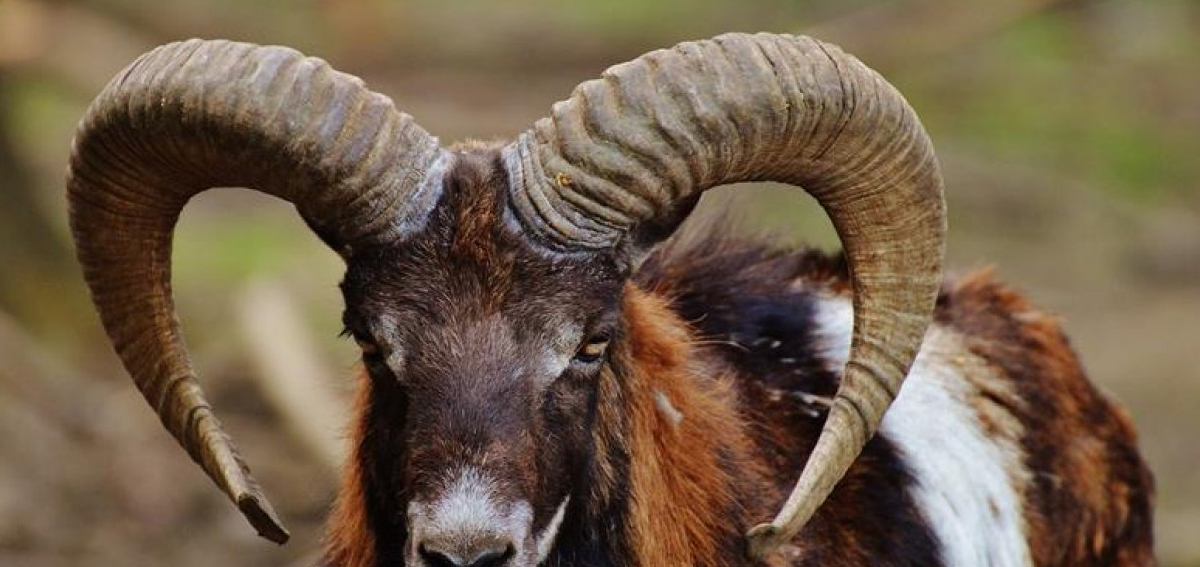

The mouflon is a widespread mammal, commonly hunted throughout Central Europe. Native to the Middle and Near East, it was introduced to the Mediterranean islands (Cyprus, Sardinia, and Corsica) about 7.000 years ago.
From these islands, it was recently introduced to the mainland and Europe, where it has reached considerable numbers, thriving in mixed and broadleaf forests. It is important to remember that on the continent, the majority of populations are the result of very recent introductions, occurring after 1970 and originating from the Miemo Wildlife and Hunting Company, in the province of Pisa. In Italy, too, the species is hunted using selective hunting methods, that is, through the assignment of a hunting plan divided into sex and age classes. The population size and structure, on which the hunting plans are based, are determined following meticulous censuses conducted by selective hunters (hunters who have obtained a specific qualification by passing a test) coordinated by wildlife technicians. Just like roe deer, red deer, fallow deer, and chamois... So, in this sense, the mouflons of Giglio Island, which are not an extremely rare subspecies to be protected at all costs, can be hunted through selective hunting like other ungulates hunted annually in Italy. If we really want to find a difference, it's that there's an eradication program for the mouflons of Giglio Island, meaning the island's population—a few dozen individuals—must be completely eliminated.
And in fact, the Tuscany Region, in full compliance with current regulations, has authorized its collection.
Are the above-mentioned subjects hunters? No. The owners of some vegetable gardens whose zucchini they eat? Not even. They are from ISPRA, which confirms the opinion issued in 2012 by the then INFS, the same scientific technical institute, which already authorized the Tuscany Region to eradicate mouflons.
What is ISPRA? those less familiar with hunting and management issues who happen to have stumbled this far may wonder. It is the institute that in our country is responsible for issuing opinions on all matters pertaining to environmental and wildlife-hunting management. In short, that institute is the Supreme Judge for animal rights activists when it removes hunting days and bans the harvest of species in complete contradiction to the decisions taken by its counterparts in the rest of Europe. But it suddenly becomes unreliable, biased, and devoid of technical and scientific knowledge when it says that, yes, those 37 animals must be removed.
Once again, we find ourselves faced with the usual animal-environmentalist confessional position, which sacrifices any scientific principle on the altar of ideology and demagoguery, proposing solutions that are technically unacceptable or useless and expensive—since it's not they who pay, but the citizens—riding the wave of a cloying pietism.
As Dr. Piero Genovesi, head of fauna at ISPRA and project manager of the Life ASAP European project to halt alien and invasive species and protect biodiversity, noted in an interview with Giglionews, "All scientific evidence confirms that mouflons are among the invasive alien species that cause significant impacts on natural habitats, and the effects are particularly severe on islands, which are extremely fragile and vulnerable ecosystems. From Hawaii to the Canary Islands, wherever this ungulate has been introduced, the effects on biodiversity are severe, both due to feeding and trampling. At least 50 plant species worldwide are threatened by this species, and in a recent global analysis of the impacts of alien ungulates, the mouflon was found to be the species with the most severe negative impacts."
As regards the threats by LAV to report hunters who proceeded to take mouflons on the Island of Giglio, we can reiterate that they are devoid of any content or substance as they are directed at authorised individuals and at an activity foreseen by regional and state regulations.
And whether these threats could constitute criminal charges is up to our lawyers; Federcaccia will act accordingly!
Let the animal rights Taliban calm down and instead of looking at the welfare of the individual sheep, let them look at that of the entire flock!
FEDERCACCIA SUPPORTS THE TUSCANY REGION FOR THE PRESSURE IT IS UNDER AND STRONGLY ASKS THAT IT NOT DEPLETE ITS TYPICAL HERITAGE OF MANAGEMENT CULTURE.
A HERITAGE THAT MUST INFORM ALL OF EVERYONE'S REGULATORY PRODUCTION IF WE WANT TO BE USEFUL TO THE ENVIRONMENT!
SUSTAINABILITY IS NOT THE CHILD OF EMOTIONALITY!
NATIONAL HUNTING FEDERATION
FEDERCACCIA TUSCANY REGION