Over the past twenty years, precision shooting has undergone unprecedented evolution. Disciplines such as Precision Rifle Shooting, Long Range, and Tactical/Sport Shooting have profoundly changed the way we think not only about rifles, but also about all the equipment that contributes to the final result.
While until a few years ago, the primary goal of a riflescope was to offer a bright image, precise turrets, and reliable mechanics, today these features are merely the starting point. Modern competitions require much more: rapid decision-making, immediate management of the ballistic solution, repeatable adjustments, and the ability to rapidly adapt to scenarios that change within seconds.
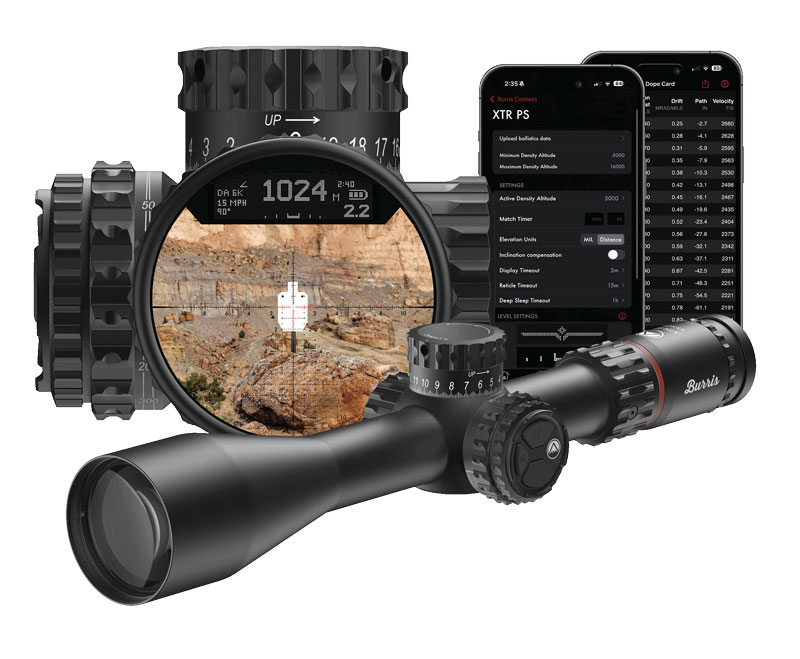
In this context the Burris XTR PS, a project that does not simply represent a new optic from the prestigious XTR family, but a platform completely redesigned to meet the needs of the modern precision shooter.
Its development starts from an extremely concrete question:
How can you reduce the time needed to prepare a shot without sacrificing maximum accuracy?
It is precisely around this philosophy that Burris has developed one of the most technologically advanced projects available today in the panorama of optics dedicated to sports shooting.

Precision shooting has changed
Observing a modern Precision Rifle Shooting competition, one immediately understands how the role of the riflescope is profoundly different from that of the past.
The shooter no longer faces a single known target, having all the time necessary to carry out ballistic calculations and calmly adjust the turret.
During a stage there may be numerous targets placed at different distances, often distributed along complex courses that require changes in position, variations in support and continuous adjustments of the shooting technique.
Every second therefore takes on fundamental importance.
The goal is not simply to hit the target, but to be able to quickly build a reliable shooting solution while maintaining the highest level of concentration.
It is precisely in this new reality that electronics begins to take on a decisive role.
Precision is no longer enough
For many years, the quality of a riflescope was judged primarily on the sharpness of the image, the robustness of the mechanics, and the precision of the turrets.
All elements that continue to represent essential requirements.
However, modern long range shooting has shown that a significant part of the errors does not depend on the quality of the optics, but on the management of information.
Range, ballistic correction, turret position, gun inclination, available time and procedure control are now variables that must be managed simultaneously.
The more information there is to process, the greater the likelihood that human error will compromise the entire shooting sequence.
The XTR PS project was born precisely with the aim of lightening this cognitive load, allowing the shooter to dedicate all his attention to the truly decisive aspects of the match.
From mechanics to operational intelligence
The construction philosophy of the XTR PS is not to replace the shooter's experience with electronics.
In reverse, Burris has developed a system capable of supporting the decision-making process, leaving the user in complete control of the weapon unchanged.
Each electronic function has been designed to reduce the number of repetitive operations and decrease the risk of errors during stage preparation.
The riflescope thus becomes a true operational assistant, capable of providing the necessary information in real time without interrupting the shooter's workflow.
This is a much more profound conceptual change than the introduction of new turrets or reticles.
The XTR family: a platform born for competition
The XTR name has occupied a reference position in the panorama of optics dedicated to precision shooting for many years now.
This family was specifically developed to offer instruments capable of satisfying the needs of the most demanding shooters, combining high optical quality, wide adjustment range, structural robustness and mechanical repeatability.
The XTR PS project represents the natural evolution of this philosophy.
It does not replace the principles that made the XTR platform famous, but expands them by introducing a digital component designed from the outset to work in perfect harmony with the mechanics of the optics.
The result is a system in which tradition and innovation coexist without compromise.
A platform designed around the shooter
One of the most interesting aspects of the project concerns the way in which the development of the human-machine interface was approached.
In fact, many electronic systems require continuous interaction with menus, buttons and configuration procedures which inevitably end up slowing down the shooter's activity.
Burris followed a completely different path.
The entire XTR PS project has been developed so that information is made available exactly when it is needed , without forcing the user to take their attention away from the target or from stage management.
Technology, therefore, does not take center stage, but works silently behind the scenes, leaving the shooter with the sensation of using an extremely natural system.
Reducing time means increasing precision
In precision shooting, the time factor is closely linked to the quality of execution.
A shooter who is able to quickly prepare his ballistic solution has more time to analyze the wind, check the position of the gun, control his breathing and concentrate exclusively on executing the shot.
This is precisely the philosophy that guides the development of the Burris XTR PS.
Every second saved in managing adjustments can be invested in observing the target and analyzing environmental conditions, thus increasing the probability of getting an accurate shot right on the first try.
It is therefore not a question of speeding up the shot, but of making the entire decision-making process that precedes it more efficient.
Much more than just a telescope
Analyzing the project in detail, it clearly emerges that the XTR PS represents something different compared to a traditional competition optic.
The quality of the lenses, the precision of the turrets and the robustness of the construction naturally form the basis of the project.
What makes the difference, however, is the ability to integrate these elements with an advanced electronic platform, designed to assist the shooter without changing his operating habits.
It's a philosophy that perfectly reflects the evolution of modern sport shooting, in which precision increasingly stems from the integration of athlete skill, quality equipment, and intelligent data management.
The beginning of a new generation
With the XTR PS Burris inaugurates a new interpretation of the riflescope dedicated to Precision Shooting.
It doesn't just improve optical quality or increase the precision of adjustments, but introduces a new way of interacting with the equipment, in which each component has been designed to simplify the shooter's work and optimize stage management.
In the second part of this study we will delve into the technological heart of the project, analyzing the system in detail PEK, the innovative Heads-Up Display, the digital management of the ballistic solution, the electronic level, the information that can be viewed during the race and all the technologies that make the Burris XTR PS one of the most advanced platforms available today for precision shooting.
The technological heart of the XTR PS: when stage management enters the riflescope
In modern precision rifle shooting, optic quality is only one of the factors that determine the final result. Impeccable mechanics, high-quality glass, and precise turrets are still essential requirements today, but they are no longer sufficient when the shooter faces increasingly dynamic stages, characterized by multiple targets, variable distances, and extremely short shooting times.
Il Burris XTR PS was born precisely to respond to this evolution. Its innovation It does not only consist in introducing new electronic functions, but in completely rethinking the relationship between the shooter and his riflescope.
The designers' goal Burris was to create a system capable of reducing the number of mental operations necessary during the course, allowing the athlete to concentrate all his attention on observing the target, reading the wind and on the quality of the execution.
PĒK: a new generation of ballistic turret
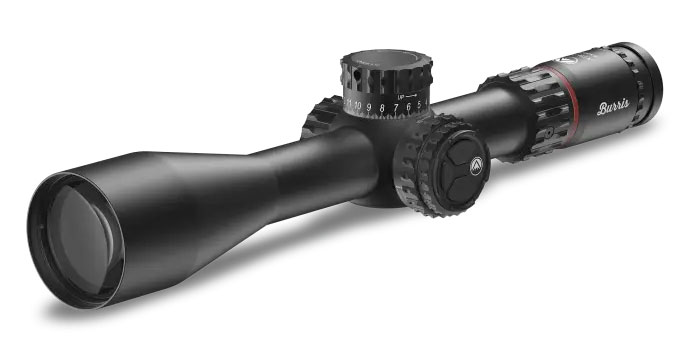
Even in the XTR PS project the absolute protagonist is the PĒK (Programmable Elevation Knob) system , already introduced on the Veracity PH platform but developed with a philosophy perfectly consistent with the needs of precision sport shooting.
However, reducing the PĒK to a simple electronic turret would be a mistake. It actually represents an intelligent interface in which mechanics, electronics, and software work as a single system.
Elevation adjustment continues to rely on extremely precise mechanics, designed to ensure repeatability and reliability even after thousands of adjustments. The difference is that every movement is monitored by high-precision sensors that constantly monitor the turret's position.
The riflescope therefore always knows which correction has been set and can immediately display it within the Heads-Up Display system.
It is a seemingly simple change but destined to profoundly modify the way of managing the ballistic solution during a competition.
Precision is no longer just mechanical
In traditional ballistic turrets the shooter must constantly remember the position of the adjustment, verify the number of clicks made and avoid any errors when returning to zero.
During a competition, this activity can become surprisingly demanding. Stress, the stopwatch, and the need to quickly change distances and shooting positions increase the risk of making seemingly trivial but often decisive errors.
With the PĒK system this process is completely rethought.
The turret position is continuously detected, verified, and made available to the shooter via the electronic display. It is no longer necessary to rely solely on memory or reading the graduated scales: the system constantly communicates the actual optic configuration.
The result is not only greater precision, but above all a significant reduction in mental load during the internship.
A Heads-Up Display designed for dynamic shooting
To fully exploit the potential of the PĒK system, it was necessary to develop an interface capable of providing truly useful information without interfering with target observation.
This is how the Heads-Up Display (HUD) integrated into the XTR PS was born, a digital display system inserted directly into the riflescope's field of view.
Unlike a traditional external display, the HUD allows the shooter to consult operational information while keeping the eye inside the optic and without interrupting the target acquisition process.
This solution helps make the transition between observation, adjustment and shot execution extremely fluid.
Eight fully customizable information areas
One of the most advanced aspects of the project is the ability to configure the display according to your operational needs.
The XTR PS HUD can display multiple pieces of information at the same time, organized into dedicated, easy-to-read areas.
The shooter can decide which data to make visible during the competition, building an interface perfectly adapted to his or her shooting style.
The main information available includes:
- ballistic correction set;
- PĒK turret status;
- electronic level;
- stage timer;
- selected ballistic profiles;
- density altitude;
- system indicators;
- customizable operational information.
This configurability allows each shooter to build a working environment perfectly consistent with the discipline practiced.
The electronic level
Among the most interesting features of the XTR PS, the integrated electronic level deserves particular attention.
Every long range shooter knows the negative effects caused by the so-called canting , or the involuntary rotation of the weapon with respect to its vertical axis.
Even minimal inclinations can cause significant deviations of the point of impact, especially when operating at long ranges.
The electronic system constantly monitors the position of the weapon and immediately reports any unwanted inclinations , allowing the shooter to correct the position before shooting.
This is a seemingly simple but extremely effective function in the search for maximum repeatability.
Density Altitude: an often underestimated parameter
One of the elements that distinguish modern precision shooting is the increasing attention to atmospheric conditions.
Temperature, pressure and humidity in fact modify the density of the air, directly influencing the behaviour of the projectile during flight.
The XTR PS integrates Density Altitude management , a parameter used by many advanced shooters to summarise the combined effect of environmental conditions on the ballistic trajectory.
Having this information directly within the system allows you to adapt the shooting solution more quickly to the actual conditions present on the field.
The integrated timer: a function designed for competitions
Among the most original features of the XTR PS is also the timer dedicated to the race stages.
It may seem like a secondary function, but those who regularly take part in competitions know perfectly well how important it is to constantly keep track of the available time.
Having the countdown directly in your field of vision allows you to better manage the pace of the stage, avoiding both unnecessary accelerations and dangerous slowdowns in the decisive phases of the test.
This feature also confirms that the XTR PS has been designed specifically with competitive activity in mind.
Technology at the service of the shooter's workflow
One of the most successful aspects of the project Burris consists in having developed all these functions without turning the telescope into a complex device to use.
Every element of the interface has been designed to fit naturally into the shooter's normal operational flow.
Information is displayed only when actually needed, avoiding overloading the field of vision with unnecessary data.
This simplicity is probably one of the greatest strengths of the entire platform.
A platform built to win against mistakes
Analysing the XTR PS project in detail, it clearly emerges what the real objective pursued by the engineers was Burris.
Don't simply increase the number of available functions, but actually reduce the number of errors a shooter can make during a competition.
The PĒK Smart Turret, Heads-Up Display, Electronic Level, Density Altitude Management, and Integrated Timer are not independent technologies, but elements of a single ecosystem designed to improve the quality of decision-making and the fluidity of the entire shooting process.
In the third and final part of this study we will enter the ecosystem BurrisConnect, analyzing the configuration of ballistic profiles, Bluetooth synchronization, advanced shot data management, the SCR 2™ reticle, the 34 mm tube, the optical quality of the XTR PS series and all the construction features that complete one of the most advanced platforms available today for Precision Rifle Shooting and Long Range.
BurrisConnect: The digital brain of the XTR PS platform
To fully understand the design philosophy of the Burris XTR PS requires a complete system overview. The PĒK smart turret, Heads-Up Display, and onboard electronics are just a small part of the package. The key to enabling all these technologies to work together as a single ecosystem is BurrisConnect, the application developed by Burris to manage, configure and update the entire platform.

The concept behind the software is simple but extremely modern: moving all the configuration operations to the smartphone, leaving the riflescope exclusively to assist the shooter during the competition.
This design choice allows for the use of a much more intuitive graphical interface than the traditional menus found on electronic optics and allows for continuous system updates without modifying the mechanical structure of the product.
The construction of the ballistic profile
Any precision shooting system is only as effective as the ballistic data it is based on. For this reason, BurrisConnect guides the shooter in creating a completely personalized profile, built around the specific combination of weapon, ammunition and optics.
During setup, all the fundamental parameters for calculating the trajectory are entered, including the caliber, bullet weight, ballistic coefficient, muzzle velocity, zeroing distance and the height of the optical axis with respect to the barrel.
The software uses this information to create an extremely precise ballistic model, which is then transferred to the riflescope via Bluetooth.
A platform designed for those who use multiple configurations
One of the most appreciated aspects by sport shooters is the possibility of managing numerous ballistic profiles within the same application.
In fact, many competitive shooters use multiple rifles or different loads depending on the discipline they are practicing, the shooting distance, or the characteristics of the stage.
BurrisConnect allows you to store all these configurations independently, quickly recalling them whenever you need to change weapons or ammunition.
The result is a significant reduction in preparation time before the race and greater safety in managing the different configurations.
Bluetooth sync
Once the ballistic profile is complete, the data is transferred to the riflescope via Bluetooth connection.
The entire procedure takes just a few moments and allows the PĒK system to perfectly understand all the characteristics of the selected configuration.
From now on, the riflescope has the information necessary to assist the shooter during each turret adjustment and to display the most important operational information on the display.
Synchronization can be repeated whenever changes are made to the ballistics data or when you want to use a different configuration.
Firmware updates: a perspective that continues to evolve
One of the aspects that most distinguishes a modern digital platform from a traditional mechanical telescope is the ability to evolve over time.
Through BurrisConnect allows you to install firmware updates that introduce functional improvements, interface optimizations, and new features developed after the product launch.
This approach allows the XTR PS to remain constantly updated even after many years of use, offering the shooter a system destined to grow together with the evolution of the software.
This feature fits perfectly with a product with a lifetime guarantee.
Optical quality designed for precision shooting
No matter how sophisticated the electronics, a riflescope intended for Precision Rifle Shooting must first and foremost offer top-level optical performance.
The XTR PS series employs ED (Extra-low Dispersion) glass , designed to reduce chromatic aberration and ensure extremely sharp images even at maximum magnifications.
Multilayer treatments applied to optical surfaces improve light transmission, increasing contrast and reducing reflections and light dispersion.
The result is a particularly sharp view that makes it easier to identify the target and read details even at long distances.
The SCR 2™ reticle in the first focal plane
Among the characterizing elements of the XTR PS we find the SCR 2™ reticle , placed on the first focal plane (FFP).
This solution allows the reticle to maintain constant ballistic proportions throughout the entire magnification range , allowing the shooter to always use the same references regardless of the zoom level selected.
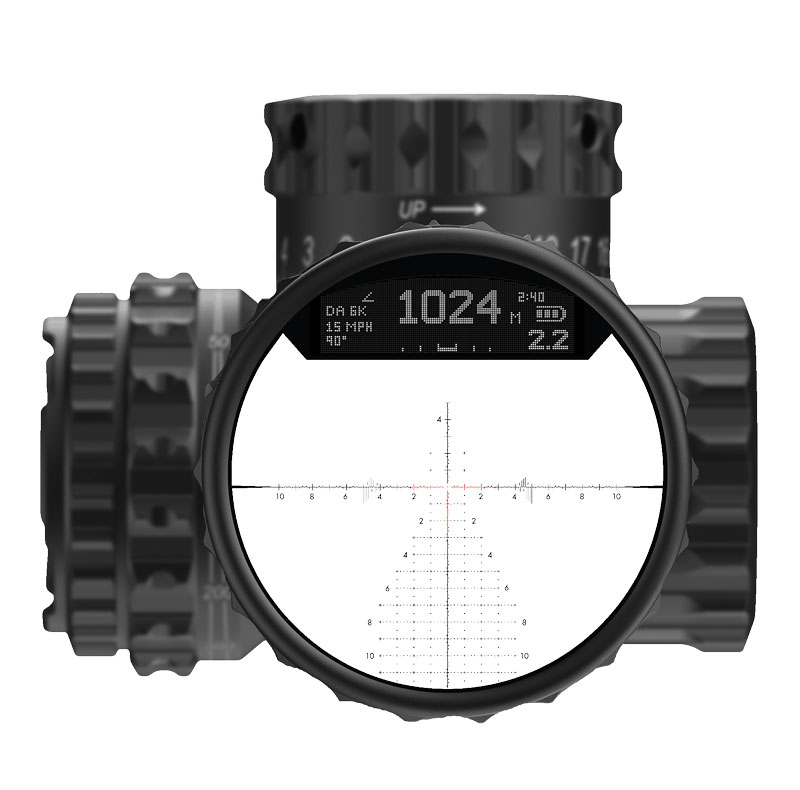
The reticle design was developed to promote speed of acquisition, precision in corrections and ease of reading during long range competitions.
34mm tube and wide adjustment range
The adoption of a 34 mm central tube does not only represent a structural choice, but responds to the need to offer a high range of ballistic adjustments.
This allows you to tackle even the most challenging distance shots with greater peace of mind, always maintaining a wide operating margin for elevation and windage adjustments.
The rigidity of the structure also helps to ensure the repeatability of adjustments even after thousands of use cycles.
Parallax and image accuracy
Parallax adjustment is one of the fundamental elements in optics dedicated to precision shooting.
In the XTR PS this system allows you to obtain a perfectly defined image free from errors due to the movement of the eye with respect to the optical axis.
Correct parallax adjustment helps improve shooting accuracy, especially when operating at long distances and with high magnifications.
Robustness designed for racing use
Every component of the XTR PS has been designed to withstand the stresses typical of sporting activity.
The monolithic aluminum alloy body offers high structural rigidity, while the inert gas filling and sealing gaskets effectively protect the optical system from dust, humidity and temperature changes.
These features ensure operational reliability even during long racing days or in particularly challenging environmental conditions.
Two configurations for different needs
The XTR PS family is offered in different magnification configurations, developed to meet the different needs of sport shooting.
The 3.3-18×50 version favors speed, versatility and management of dynamic stages, while the 5.5-30×56 configuration is oriented towards long range competitions and applications that require the highest level of detail at long distances.
Although they differ in terms of magnification range, both share the same design philosophy, the same electronic architecture and the entire ecosystem BurrisConnect.
A new interpretation of the competition riflescope
Analysing the project as a whole it clearly emerges that the Burris XTR PS represents much more than a simple evolution of the XTR series.
The integration of optical quality, precision mechanics, PĒK intelligent turret, Heads-Up Display and platform BurrisConnect gives rise to a completely new system, designed around the real needs of the modern sports shooter.
Technology does not replace the athlete's experience, but enhances their skills by reducing the time needed to manage the ballistic solution and limiting the possibility of error in the most delicate phases of the competition.
It is a philosophy that perfectly interprets the evolution of Precision Rifle Shooting, a discipline in which speed of decision-making, precision, and information management today take on an importance equal to that of the quality of the weapon and the technical preparation of the shooter.
Final houghts
With the XTR PS Burris demonstrates how the future of competition optics lies not only in increasing magnification or improving lens quality, but above all in the ability to integrate mechanics, electronics and software into a single, perfectly coordinated ecosystem.
The result is a platform that retains all the features required of a professional optic — ruggedness, precision, reliability, and optical quality — while adding digital tools designed to concretely improve the shooter's workflow.
More than just a telescope, the Burris XTR PS represents a new concept of precision shooting: an intelligent system developed to accompany the shooter through every phase of the competition, transforming the management of the ballistic solution into a faster, more intuitive and, above all, more effective process.