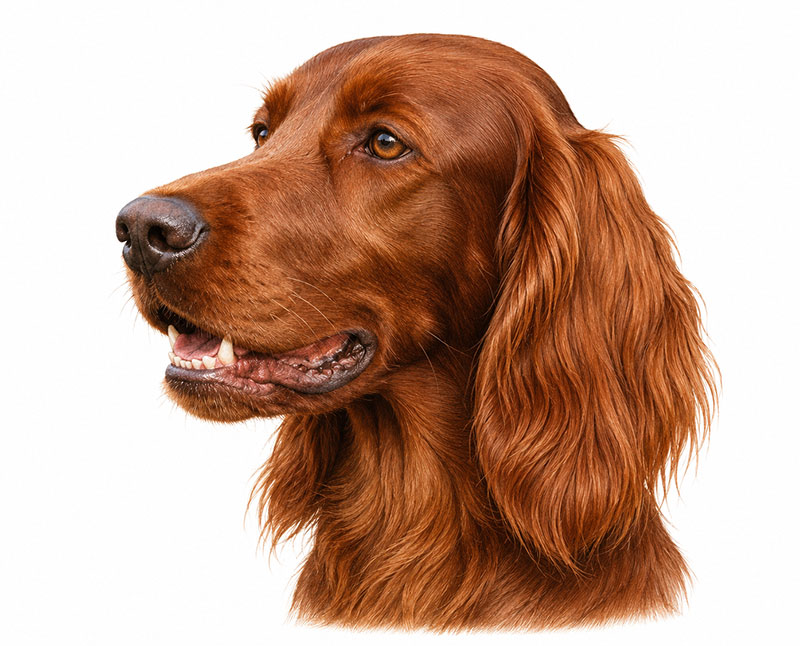
The Irish Red Setter , known internationally as the Irish Red Setter and often simply called the Red Setter , is one of the most elegant and spectacular of the British and Irish pointing dogs . Its distinctive mahogany red coat, athletic build, and flowing gait have made it an instantly recognizable breed, but behind the undeniable beauty lies above all a dog selected for hunting feathered game.
The Irish Setter is a dynamic, fast-moving auxiliary dog with a wide search, capable of exploring large areas by effectively using the wind and its scent. Its hunting action is characterized by passion, initiative, elegant movement, and the ability to point from a distance.
When it comes from lines truly selected for work and is properly trained, the Red Setter can be an excellent companion for the hunter who loves a lively, athletic dog capable of covering a lot of ground while maintaining a fluid and continuous action.

Irish Red Setter: identity card
| Official name | Irish Red Setter |
| Italian name | Irish Red Setter |
| Commonly used name | Red Setter |
| country of origin | Ireland |
| Hunting category | Pointing dog |
| FCI Classification | Group 7 – Pointing Dogs |
| Section | British and Irish Pointing Dogs – Setters |
| FCI Standards | N. 120 |
| Test of work | Expected |
| Size | Media |
| Male height | 58-67 cm |
| Female height | 55-62 cm |
| cloak | Deep brown red, without traces of black |
| Hair | Short and fine on the head; longer and fringed on the body, limbs and tail |
| Temperament | Energetic, intelligent, lively and passionate |
| Main attitude | Searching and stopping feathered game |
The main hunting skills of the Irish Setter
| Ferme | ★ ★ ★ ★ ★ |
| Search | ★ ★ ★ ★ ★ |
| Smell | ★ ★ ★ ★ ★ |
| Swift | ★ ★ ★ ★ ★ |
| Search breadth | ★ ★ ★ ★ ★ |
| Resistance | ★ ★ ★ ★ ★ |
| Adaptation to the forest | ★★★★ ☆ |
| I'm reporting | ★★★ ☆☆ |
| Work in water | ★★★ ☆☆ |
| Connection with the conductor | ★★★★ ☆ |
The ratings provided are indicative and describe the aptitudes generally associated with the breed. Individual qualities may vary depending on bloodline, selection, experience, and training.
The Irish Setter in a nutshell: speed, style, and great passion
The Irish Red Setter is a dog that tends to express its hunting nature through dynamic and spectacular action. Its search is generally wide, fast, and conducted with great initiative, characteristics that make it particularly attractive in environments where large areas must be explored quickly.
However, its quality should not be judged solely by speed. A good Red Setter must correctly use the wind, interpret its emanations, maintain a functional relationship with the handler, and demonstrate confidence when entering the area where game is present.
It is therefore a dog in which style and hunting practicality must proceed together.
Origins and history of the Irish Red Setter
The Irish Red Setter was developed in Ireland as a working dog for hunting . The breed's origins are historically linked to the Irish Red and White Setter and other pointing dogs found on the island.
The progressive selection of the single-coloured coat led to the definition of the modern Irish Red Setter, whose type was already substantially consolidated during the 18th and 19th centuries.
An important step in the history of the breed occurred in 1882 with the founding of the Irish Setter Club. A few years later, in 1886, the Club published an official standard and contributed to the organization of shows and working trials aimed at preserving the morphological and functional characteristics of the breed.
The history of the Irish Setter thus demonstrates how beauty and work have always been considered two closely related components. Modern selection has produced lines with even different characteristics, but the original identity remains that of a large pointing dog for hunting feathered game.
Red Setter: Why this name became so widespread
The name Red Setter naturally derives from the breed's distinctive red coat. In everyday language, it is frequently used as a synonym for Irish Red Setter, especially in hunting circles.
It is useful, however, to distinguish the Irish Red Setter from the Irish Red and White Setter , which is a distinct breed and has its own standard.
The term Red Setter therefore identifies the subject with the characteristic solid red-brown coat, which over time has become one of the most recognisable dogs in the world of dog breeding.
Morphology of the Irish Red Setter
The Irish Setter must express athleticism, harmony, and elegance . Its build is that of a dog designed for galloping and sustained physical activity on the ground.
The head is long and lean, with an intelligent expression. The ears are moderately sized, fine, and close to the head.
The neck is muscular without appearing heavy and fits harmoniously into an athletic body. The chest should allow for efficient breathing, while the back, loins, and limbs should allow the dog to develop ample and economical movement.
The musculature should be evident but never coarse. Overall, the Irish Setter should appear as a true hunting athlete , capable of combining speed, endurance, and lightness of movement.
The red coat of the Irish Setter
The coat naturally represents one of the distinctive elements of the breed.
The color must be a deep chestnut red , without any traces of black. Small white markings in certain areas are possible without necessarily compromising the typical nature of the subject.
The hair on the head and front of the limbs is short and fine, while it becomes longer on the rest of the body. The ears, limbs, belly, and tail feature characteristic feathering that contributes to the breed's elegance.
In dogs intended for hunting, the coat requires regular grooming, especially after outings in thick vegetation, where seeds, small branches, thorns and plant material can accumulate.
The Irish Setter on the hunt: how it works
It is on the ground that the hunting Red Setter shows its true personality.
Its action is generally characterized by a sustained, fluid, and wide-ranging gallop . The dog searches for ground decisively and tends to exploit available spaces to locate game by smell.
A good Irish Setter, however, must not run without method. He must distribute his search effectively, use the wind correctly, and maintain sufficient connection with his handler.
Speed must therefore be considered a tool of the search and not its objective.
The Search for the Irish Setter
The Irish Setter's search is one of the elements that most characterize the breed.
In open spaces, it can develop over considerable distances, allowing the dog to quickly explore large areas. However, the action must remain organized with respect to the wind direction and the handler's position.
As the terrain becomes more confined, experience should lead the dog to reduce the width and adapt its behavior.
This ability to change the size of the search according to the terrain is a fundamental element in transforming a fast dog into a true hunting aid.
The Red Setter's gallop
The gallop is a particularly important component of the breed style.
The movement should appear fluid, fast, and economical . A dog destined to work for several hours cannot continually waste energy with inefficient action.
The athletic build of the Irish Setter allows a properly trained individual to maintain good speed even during busy days.
It is precisely the combination of conformation, gallop and endurance that allows him to effectively cover large surfaces.
The Irish Setter's sense of smell
Olfactory abilities are naturally one of the fundamental qualities of any great pointing dog.
The Irish Setter must be able to work mainly on airborne scent, using wind and terrain conformation to locate the presence of game.
When encountering an interesting scent, a dog's behavior changes. Speed, posture, and direction of action may gradually change as he tries to pinpoint the scent's origin.
The ability to interpret this passage is one of the most fascinating elements of an expert Setter's work.
The Irish Setter Pointing
The Red Setter's point must be confident and expressive, a consequence of a correct interpretation of the emanation.
When the dog locates the game, it stops running and assumes a position that allows the handler to immediately understand the situation.
A good pointer shouldn't be evaluated solely from an aesthetic standpoint. Above all, it must be functional and allow the hunter to approach without the dog exerting unnecessary pressure on the game.
Experience and knowledge of the different species play a crucial role. The behavior required when dealing with a grey partridge is not necessarily identical to that required when dealing with a woodcock or a pheasant prone to stalking.
Game management and guidance
When the game tends to move away, the Irish Setter must be able to interpret the situation while maintaining contact with the scent.
The guided tour requires a balance between initiative and prudence.
An overly impetuous subject can exert excessive pressure on the game; an overly cautious dog can instead lose effectiveness.
The experience gained through real encounters therefore represents one of the fundamental elements in the maturation of a great pointing dog.
The ideal terrain for the Irish Setter
| Open plain | ★ ★ ★ ★ ★ |
| Collina | ★ ★ ★ ★ ★ |
| Mountain | ★★★★ ☆ |
| The Forest | ★★★★ ☆ |
| Very thick vegetation | ★★★ ☆☆ |
| Wetlands | ★★★ ☆☆ |
Open environments allow the Irish Setter to fully express speed, range of motion and ability to exploit the wind.
Plain etc.ollinthey therefore represent scenarios that are particularly congenial to the breed.
This doesn't mean a Red Setter can't be effective in the woods. A properly selected and experienced dog should be able to reduce its search and adjust its behavior based on visibility and the shape of the environment.
What game can you hunt with an Irish Setter?
The Irish Setter was bred primarily for hunting and pointing feathered game . Some breeds allow the breed's characteristics to be particularly highlighted.
Gray partridge
Attitude: ★★★★★
The open environments frequented by the grey partridge allow the Red Setter to exploit its search range, speed, sense of smell and ability to work on the wind.
Partridge
Attitude: ★★★★★
Partridge hunting often requires athleticism and endurance on challenging terrain. A properly trained Irish Setter can demonstrate much of its physical qualities here.
Quail
Attitude: ★★★★☆
Quail requires careful work and the ability to interpret emanations that can be delicate and fragmentary.
Pheasant
Attitude: ★★★★☆
Pheasant hunting especially tests a dog's ability to handle game that tends to frequently move across the ground. Experience, caution, and guidance skills are essential.
Woodcock
Attitude: ★★★★★
The Irish Setter can be an extremely useful companion when hunting woodcock . In the woods, however, the dog must learn to scale back the search and maintain an effective connection with the handler.
A large nose, stamina and the ability to face long days can be particularly important qualities when the subject has specific experience with game.
Irish Woodcock Setter
Woodcock hunting deserves special attention because it represents one of the activities that most interests Italian hunters.
A good Red Setter for woodcock hunting must be able to combine initiative and communication. In the woods, a simply extensive search isn't helpful: instead, you need to explore the most promising areas while maintaining a functional relationship with the hunter.
The dog must gradually learn to recognize shelters, interpret wind and vegetation, and adapt to the behavior of a particularly difficult species.
The great woodcock, therefore, is not born solely from natural qualities. It is the result of a combination of genetics, experience, game, and many hours of work in the field.
Retrieving in the Irish Setter
Retrieving is generally not the most characteristic component of the breed as much as searching and pointing, but it can be developed through correct work.
A subject used in practical hunting should be able to assist in the recovery of shot game, especially when it falls into vegetation that makes it difficult to locate.
Individual predisposition and training can determine significant differences between different subjects.
How to recognize a good Irish Setter on the ground
A good Irish Setter should not be judged simply by how much he runs.
The overall quality emerges from the balance between:
speed, range of search, use of the wind, sense of smell, method, initiative, connection, ability to take point, sureness in pointing and adaptation to the terrain.
A very fast dog that is unable to use the terrain correctly will hardly be as effective as one that is able to use its athletic qualities to help it track game.
The true quality of the Red Setter is therefore represented by the functionality of its action.
Irish Setter Character
The Irish Setter is generally a lively, energetic, intelligent and particularly active dog.
Its temperament requires exercise and stimulation. This characteristic should be taken into account, especially by those choosing a puppy with the breed's elegance in mind.
The Red Setter was born to move and work. It therefore requires physical activity and a continuous relationship with its owner, even outside of hunting season.
Proper training allows you to direct energy and initiative without compromising the dog's personality.
The relationship between Red Setter and hunter
Connection is a fundamental aspect especially in subjects with a very broad search.
The dog must develop sufficient autonomy to effectively explore the terrain, but at the same time maintain awareness of the handler's position and movement.
The ideal connection doesn't come from constant calls. A mature individual should learn to collaborate spontaneously with the hunter , adapting trajectories and amplitude to the characteristics of the situation.
Irish Setter Training
The training of the Red Setter must aim above all to enhance the natural qualities of the breed without limiting its passion and initiative.
Education of base
Recall, socialization and relationship with the handler form the foundations of future hunting work.
The first releases
During the first experiences it is important to allow the young dog to explore and gradually develop confidence and autonomy.
Too rigid a control can reduce initiative and the desire to search.
The encounter with the game
Experience in the wild is a crucial moment. Only through correct and repeated encounters can the young Setter learn to interpret different scents and behaviors.
Stops her
The natural predisposition must be progressively consolidated by avoiding unnecessarily traumatic or excessively mechanical interventions.
I shoot him
The habit of shooting must be introduced gradually, without forcing and possibly associated with positive experiences with game.
The carryover
When you want to develop this ability, the work must be gradual and based on collaboration rather than coercion.
Red Setter's athletic preparation
The Irish Setter's structure and working style require adequate athletic preparation.
A dog destined to gallop for several hours cannot face the hunting season after a long period of inactivity.
Training must be progressive and aimed at developing:
cardiovascular endurance, musculature, movement efficiency, foot strength, and recovery ability.
During the busiest days, hydration, ambient temperature and adequate recovery periods also take on particular importance.
Coat care after hunting
The Irish Setter's distinctive coat requires a little more attention than short-haired breeds.
After a day spent in the woods or in tall vegetation it is advisable to carefully check:
ears, fringes, armpits, interdigital spaces, tail and belly.
Spikes, seeds, small branches and plant material can in fact remain trapped in the mantle.
Regular brushing also helps keep the coat in good condition and quickly identify any small skin lesions.
Irish Setter Health and Management
The choice of puppy should be made by turning to breeders who pay attention to the health, character, morphology and working aptitude of the breeders.
It is advisable to find out about the health checks required or recommended for the breed and the genealogical characteristics of the lines used.
For dogs intended for hunting, proper nutrition, weight control, regular exercise, parasite prevention and periodic veterinary evaluations are also of great importance.
Is the Irish Setter the right hunting dog for you?
| Ferme | ★ ★ ★ ★ ★ |
| Swift | ★ ★ ★ ★ ★ |
| Search breadth | ★ ★ ★ ★ ★ |
| Smell | ★ ★ ★ ★ ★ |
| Resistance | ★ ★ ★ ★ ★ |
| Energy | ★ ★ ★ ★ ★ |
| Trainability | ★★★★ ☆ |
| connection | ★★★★ ☆ |
| Need for physical activity | ★ ★ ★ ★ ★ |
| Suitable for the dynamic hunter | ★ ★ ★ ★ ★ |
The Irish Setter is particularly suitable for the hunter who appreciates a fast, athletic, elegant dog with an important search.
It can be an excellent choice for those who practice hunting with pointing dogs and want an auxiliary capable of facing long days in the field.
However, it requires movement, continuity in management and an activity compatible with its considerable energy.
Irish Setter: Strengths and Aspects to Consider
| Key features | Aspects to consider |
|---|---|
| Great speed | High need for physical activity |
| Search broad and bright | It requires good work on the connection |
| Excellent olfactory qualities | Great energy must be directed |
| Ferme | It is important to choose lines that are truly selected for hunting. |
| Great resistance | Requires athletic training |
| Adaptability to different terrains | The coat requires checks after work |
| Great hunting passion | Not suitable for an excessively sedentary lifestyle |
| Elegance and work style | There can be important differences between working lines and more show-oriented lines. |
Irish Setter and English Setter: what are the differences?
The comparison between the Irish Setter and the English Setter is inevitable because both breeds belong to the large Setter family, but have different morphological, historical and working characteristics.
The English Setter is extremely popular in Italian hunting dog breeding and is appreciated for its olfactory qualities, style, point and great ability to adapt to different terrains.
The Irish Setter has its own identity, characterised by its typical red coat and a generally dynamic, athletic and particularly spectacular action.
However, the actual differences must be evaluated while also considering selection, bloodlines, and individual characteristics. Therefore, the comparison between Red and English Setters deserves a specific analysis.
Irish Setter and Gordon Setter
The Gordon Setter represents another important breed of the Setter family, immediately distinguishable by its characteristic black and tan coat and a generally more substantial structure.
The Red Setter, on the other hand, appears lighter and particularly oriented towards dynamic and fast action.
Both breeds can be excellent pointing aids, but they express their work through different characteristics that must be considered in relation to the terrain, the game and the hunter's preferences.
Irish Red Setter and Irish Red and White Setter
It is important not to confuse the Irish Red Setter with the Irish Red and White Setter.
Although they share a significant part of Irish hunting history and tradition, they are today recognised as two distinct breeds.
The Red Setter has the characteristic solid red-chestnut coat, while the Irish Red and White Setter has a white background with well-defined red areas.
Both breeds maintain a strong hunting vocation and deserve separate entries in the Atlas of Hunting Dogs.
Irish Setter-like breeds to know
Anyone who appreciates the Red Setter should also look into the other great British and Irish pointing dogs.
English Setter – probably one of the best-known and most used pointing dogs by Italian hunters, endowed with great style and notable olfactory qualities.
Gordon Setter – Scottish setter with a more important structure, characterised by the typical black and tan coat.
Irish Red and White Setter – ancient Irish breed closely related to the origins of the modern Red Setter.
English Pointer – great specialist in searching and pointing, famous for speed, range and style.
Why choose an Irish Setter for hunting
The Irish Red Setter represents a particularly attractive choice for those who want an athletic, fast pointing dog with a great passion for hunting.
Its value lies not only in its unmistakable red coat or elegant movement. Its most important characteristics are its ability to effectively cover ground, harness the wind, locate game, and convert speed into a functional search.
When genetic selection, experience, training and athletic preparation meet correctly, the Red Setter can become a high-level auxiliary, capable of simultaneously expressing style, smell, resistance, determination and hunting concreteness.
It is precisely this combination of beauty and function that makes the Irish Red Setter one of the great protagonists of the history and culture of pointing dogs.