The Spinone Italiano is one of the oldest and most distinctive Italian pointing dog breeds . Hardy, resistant, methodical, and endowed with excellent scenting abilities, it represents a particular interpretation of the continental dog: less interested in excessive speed and deeply oriented towards the concreteness of work, the bond with the hunter, and the ability to tackle any terrain.
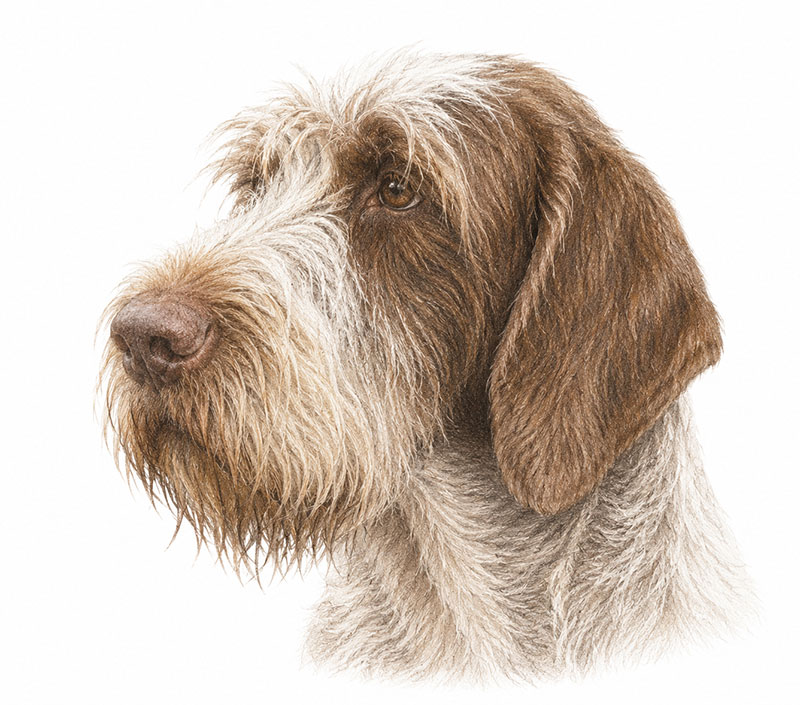
The Spinone's distinctive hard coat, beard, marked eyebrows, and solid build make it instantly recognizable. These characteristics, however, should not be read merely aesthetically. Its body and fur have been shaped to allow it to work in the forest, in brambles, in humid areas, in the plains, collinae mountain, facing challenging vegetation and climatic conditions.
The Italian Spinone is above all a complete helper . It searches, points, guides, retrieves, and brings back, generally demonstrating a natural predisposition for working in the water as well. Its strength lies in the balance between its sense of smell, method, endurance, hunting intelligence, and cooperation with its handler.
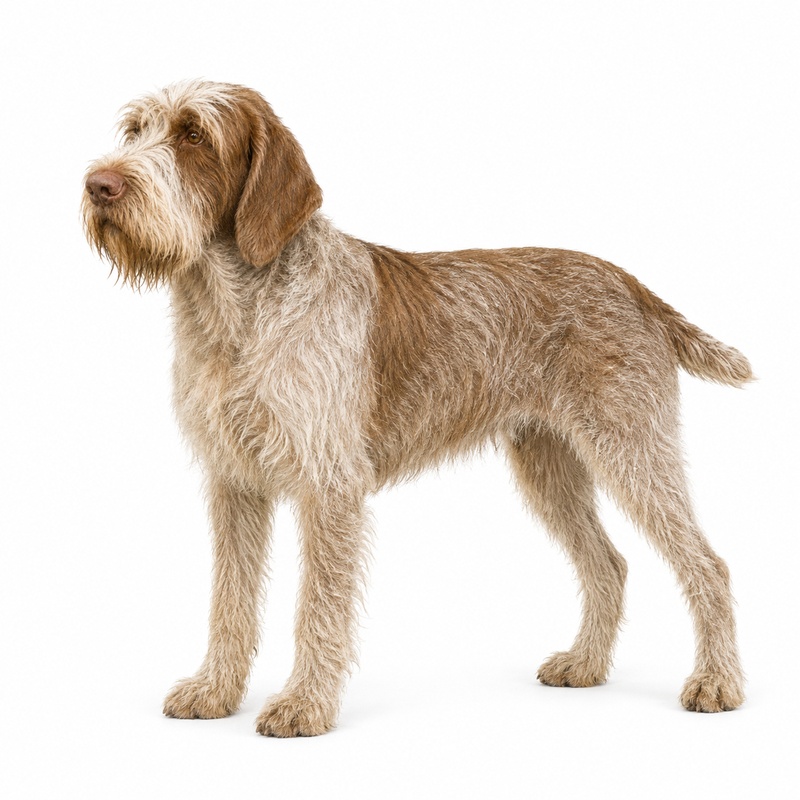
Spinone Italiano: identity card
| Official name | Spinone Italian |
| country of origin | Italy |
| Hunting category | Continental Pointing Dog |
| FCI Classification | Group 7 – Pointing Dogs |
| Section | Continental Pointing Dogs – Griffon Type |
| FCI Standards | N. 165 |
| Test of work | Expected |
| Male height | 60-70 cm |
| Female height | 58-65 cm |
| Construction | Solid, rustic, vigorous and tending towards square |
| Hair | Hard, thick and adherent |
| Characteristic colors | White, orange-white, orange roan, brown-white, brown roan |
| Temperament | Sociable, docile, patient and collaborative |
| Main attitude | Search, point, retrieve and bring back |
The main hunting skills of the Italian Spinone
| Smell | ★ ★ ★ ★ ★ |
| Ferme | ★ ★ ★ ★ ★ |
| Search | ★ ★ ★ ★ ★ |
| I'm reporting | ★ ★ ★ ★ ★ |
| Recovery | ★ ★ ★ ★ ★ |
| Work in water | ★ ★ ★ ★ ★ |
| Resistance | ★ ★ ★ ★ ★ |
| Work in difficult vegetation | ★ ★ ★ ★ ★ |
| Connection with the conductor | ★ ★ ★ ★ ★ |
| Adaptability to terrain | ★ ★ ★ ★ ★ |
| Swift | ★★★ ☆☆ |
| Hunting versatility | ★ ★ ★ ★ ★ |
The evaluations are indicative and describe the aptitudes generally associated with the breed. Individual performance depends on pedigree, selection, experience, athletic preparation, and training.
Spinone Italiano in a few words: method, nose and rusticity
To truly understand the Spinone Italiano one must avoid judging it using the parameters of the great British gallopers.
Its hunting style follows a different philosophy. The Spinone must read the terrain, use the wind, identify the most promising areas, and proceed steadily , without wasting energy on aimless pursuits.
Pure speed, therefore, isn't the primary parameter. Much more important are the ability to maintain performance over time, the precision of smell, and spontaneous adaptation to environmental conditions.
It is a dog that tends to prioritize the solution to the hunting problem rather than the spectacular nature of the action.
Origins and history of the Italian Spinone
The Italian Spinone belongs to a very ancient tradition of wire-haired pointing dogs present in the Italian peninsula.
Historical documentation of dogs related to the Spinone type spans many centuries. The FCI standard itself recalls how literature has long described a wire-haired Italian dog considered the ancestor of the modern Spinone. :contentReference[oaicite:1]{index=1}
In 1683, the French writer Sélincourt, in his work Le parfait chasseur , mentioned a "griffon" from Italy. This testimony is particularly interesting because it confirms that the Italian wire-haired type was known beyond national borders as early as the 17th century. :contentReference[oaicite:2]{index=2}
Over time, the practical selection carried out by Italian hunters progressively consolidated a dog capable of working in extremely different environments, from plains to humid areas, from woods to colline.
The Spinone in the Italian hunting tradition
The history of the breed is deeply linked to the need to have a dog capable of tackling difficult territories and variable weather conditions.
Italy, in fact, presents an extraordinary environmental variety and the Spinone was selected precisely to adapt to this complexity.
The dog had to be robust, resistant, capable of entering vegetation, working in water and maintaining contact with the hunter during long days.
This functional selection still explains many of the characteristics of the breed today.
The rebirth of the modern Italian Spinone
Like many historical European breeds, the Spinone also went through periods in which its population decreased and the spread of foreign breeds put pressure on national selection.
In the twentieth century, an important recovery and valorization work allowed the type to be consolidated again and the functional characteristics of the breed to be maintained.
Modern selection has tried to simultaneously preserve morphological typicality, rusticity and working quality , avoiding the Spinone becoming simply a show dog.
Morphology of the Italian Spinone
The Spinone is a dog with a solid, rustic, and vigorous build , with strong bones and well-developed muscles. ENCI also emphasizes how its build tends towards the square. :contentReference[oaicite:3]{index=3}
The structure must offer power and resistance without becoming unnecessary heaviness.
The chest is important, the back strong and the limbs must allow for prolonged work on different terrains.
The overall impression should be that of a dog capable of facing a difficult day without losing efficiency.
The head of the Italian Spinone
The head is one of the most characteristic parts of the breed.
The muzzle is strong and the nose well developed, with wide nostrils, consistent with the great importance of the sense of smell.
The beard and eyebrows contribute to the Spinone's typical serious and almost thoughtful expression.
The eyes have a particularly sweet and intelligent expression, while the hanging ears complete the typical appearance of the breed.
The Spinone's wire-haired coat
The coat represents one of the fundamental functional characteristics of the Italian Spinone.
The coat must be hard, thick and close-fitting and help protect the skin during work.
The structure of the coat allows the dog to tackle brambles, bushes, undergrowth and aggressive vegetation with greater protection than short-haired breeds.
The hardness of the hair is therefore a functional characteristic and not simply an aesthetic one.
Why is the Spinone called that?
The name Spinone is traditionally linked to the dog's ability to work in thorny vegetation and difficult terrain.
Brambles and bushes represent environments in which the hard coat and robustness of the breed take on a concrete value.
The name therefore sums up very well the image of a dog built to enter where the wild finds refuge, without being discouraged by the vegetation.
The colors of the Italian Spinone
The Spinone presents some very characteristic chromatic combinations.
Among the best known we find:
White;
white and orange;
orange roan;
white with brown spots;
brown roan.
The distribution of spots can vary considerably between subjects, without naturally influencing the hunting value of the dog.
The Italian Spinone Hunting: How It Works
The work of the Spinone Italiano must be interpreted through method, smell and continuity.
The dog explores the terrain mainly using airborne emanations, but must be able to adapt its behavior to environmental conditions.
When it perceives an interesting emanation, it progressively changes its action, trying to precisely locate the game.
His style must not be exaggerated: what counts is the effectiveness with which he manages to transform the search into an encounter and a stop.
The trot of the Italian Spinone
The trot is one of the characteristic gaits of the breed during work.
The Spinone must proceed with a broad, regular action capable of ensuring a good balance between speed and energy expenditure.
This gait contributes to his reputation as a great long-distance runner.
Trotting allows the dog to cover ground while simultaneously maintaining olfactory concentration and continuity for prolonged periods.
The Search for the Italian Spinone
The search for the Spinone must be diligent and adapted to the actual conditions of the terrain.
In open spaces the dog can increase the width, while in the woods or in thick vegetation it must spontaneously narrow the action.
The ability to change the search pattern is one of the most important characteristics of the great hunting dog.
The Spinone must not cover the ground randomly: it must hunt useful areas.
The Italian Spinone's sense of smell
The Spinone's nose represents one of the breed's main strengths.
The dog must be able to detect emanations even in difficult conditions and interpret them precisely.
Olfactory quality becomes particularly important in the woods, in dense vegetation and on days characterised by irregular winds.
Experience and intelligence gradually allow the dog to understand which emanations are really worth exploring further.
The taking of point
When it enters the area affected by the emanation, the Spinone progressively changes its behavior.
The speed decreases and the dog tries to establish the origin and distance of the game more precisely.
This phase must be controlled and cautious, especially when the game tends to move on the ground.
The Italian Spinone's Stop
Pointing naturally represents one of the fundamental characteristics of the breed.
The dog must remain still when it is certain of the game's position, allowing the hunter to approach.
The Spinone's point must above all be safe and functional.
Aesthetic spectacle is secondary to the ability to correctly locate and control game.
The Spinone Guide
When the wild tends to stalk, the guided comes into play.
The Spinone must advance cautiously while maintaining contact with the emanation.
This phase particularly enhances the methodical nature of the breed.
Pheasants and other game that tend to move across the ground can test a dog's ability to find the right balance between caution and determination.
The retrieve in the Italian Spinone
Retrieving represents an important component of the Spinone 's hunting completeness.
After the shot, the dog must be able to locate the killed game, retrieve it and bring it back to the handler.
This predisposition completes the search and point work and makes the Spinone particularly interesting for the hunter who wants a versatile auxiliary.
The Italian Spinone and work in the water
The predisposition to water is one of the best known characteristics of the breed.
The ENCI standard describes the Spinone as a dog expert on all terrains, very resistant to fatigue and capable of entering cold water with determination. :contentReference[oaicite:4]{index=4}
Structure, hardiness and temperament allow the dog to deal with humid areas and retrieve from water with great effectiveness.
This characteristic greatly expands the possibilities of use compared to many breeds specialized almost exclusively in pointing.
The carryover from the water
A properly trained subject can become an excellent retriever even in the aquatic environment.
The dog must enter without hesitation, locate the downed head and return to the handler while maintaining controlled behavior.
As always, natural predisposition must be enhanced through gradual and positive exposure to water from a young age.
The Italian Spinone in woodcock hunting
Attitude: ★★★★★
Woodcock hunting with the Italian Spinone represents one of the uses in which many characteristics of the breed acquire particular value.
The forest requires a nose, connection, endurance, the ability to reduce the search and above all experience in managing complex emanations.
The hard coat also offers good protection when the dog has to cross brambles and undergrowth.
A great woodcock Spinone does not necessarily seek to impress with speed: instead he must read the woods, identify the shelters and methodically solve the olfactory problem.
The Spinone in the woods
The forest represents an environment in which the rusticity of the Spinone finds full expression.
The dog must be able to penetrate the vegetation without losing contact with the hunter.
The search must become shorter, more careful and adapted to visibility.
The combination of its hard fur, sense of smell, and method can make it particularly effective in indoor environments.
Italian Spinone and Pheasant
Attitude: ★★★★★
The pheasant is one of the game birds on which the Spinone can express its search, pointing, driving and retrieving skills in a very complete manner.
The pheasant's tendency to stalk requires experience and the ability to maintain contact with the scent without over-forcing the game.
The recovery predisposition completes the work after the shot.
Italian Spinone and Partridge
Attitude: ★★★★★
The partridge allows the Spinone to effectively use wind, smell and methodical search in open environments.
The dog can expand the action, while maintaining an orderly and connected work.
The ability to gradually approach the brigade without applying excessive pressure is an important element.
Italian Spinone and quail
Attitude: ★★★★★
The quail allows you to enhance above all olfactory precision and sureness of the point.
The search must adapt to the available spaces and wind conditions.
The experienced dog quickly learns to change the rhythm and geometry of the action depending on the terrain.
Italian Spinone and partridge
Attitude: ★★★★☆
Partridge hunting can require considerable physical effort, especially in mountainous areas.
The Spinone has great endurance and stamina, but must be properly trained to tackle long differences in altitude.
An athletic individual with the right weight can demonstrate remarkable consistency even in these environments.
Italian Spinone and Snipe
Attitude: ★★★★★
Wetlands can particularly enhance the functional heritage of the breed.
The common snipe requires olfactory precision and the ability to navigate difficult and often waterlogged terrain.
The Spinone's predisposition to an aquatic environment represents a concrete advantage in this case.
What game can you hunt with an Italian Spinone?
| Woodcock | ★ ★ ★ ★ ★ |
| Pheasant | ★ ★ ★ ★ ★ |
| Gray partridge | ★ ★ ★ ★ ★ |
| Quail | ★ ★ ★ ★ ★ |
| Snipe | ★ ★ ★ ★ ★ |
| Partridge | ★★★★ ☆ |
| Water game | ★ ★ ★ ★ ★ |
The ideal soils for Spinone Italiano
| The Forest | ★ ★ ★ ★ ★ |
| Dense vegetation | ★ ★ ★ ★ ★ |
| Wetlands | ★ ★ ★ ★ ★ |
| Collina | ★ ★ ★ ★ ★ |
| Pianura | ★ ★ ★ ★ ★ |
| Mountain | ★★★★ ☆ |
| Rough terrain | ★★★★ ☆ |
The official standard emphasizes the Spinone's ability to be an expert hunter on all terrains . :contentReference[oaicite:5]{index=5}
This is probably one of the qualities that best sums up the breed: it does not have a single ideal environment, but is able to modify its behavior in relation to the territory.
Is the Spinone Italiano a slow dog?
One of the most widespread clichés concerns the Spinone's supposed slowness.
It is more correct to speak of a different philosophy of movement.
The Spinone was not selected to compete with the Pointer and Setter in extreme speed or in great, exasperated pursuit.
Instead, it must work at a profitable and sustainable pace, maintaining concentration and performance for prolonged periods.
Speed must therefore always be judged in relation to the function.
The Spinone as a cross-country skier
One of the main qualities of the breed is resistance to fatigue , an element explicitly mentioned in the official standard. :contentReference[oaicite:6]{index=6}
The dog must be able to work for many hours without losing its ability to smell and concentrate.
This feature makes it particularly interesting on busy days and on hunts where the game is scattered and requires long scouting.
How to recognize a good Italian Spinone on the ground
A great Spinone should not be judged solely by its morphology or the beauty of its stance.
The entire work must be observed:
smell, method, search, trot, connection, point holding, point, guided, retrieving, water, bottom and adaptability.
True quality emerges from the continuity with which these characteristics are used.
The dog must give the impression of hunting intelligently , avoiding unnecessary movements and concentrating on truly promising areas.
Character of the Italian Spinone
ENCI describes the Spinone as a dog with a sociable, docile and patient nature . :contentReference[oaicite:7]{index=7}
This predisposition generally makes it easy to build a very close relationship with the owner.
Docility, however, should not be confused with a lack of initiative.
On the ground, the dog must be able to make decisions and solve hunting problems independently while maintaining a strong connection.
The Italian Spinone and its family
The balanced character generally allows the Spinone to integrate well into family life.
It is important to remember, however, that it remains an active hunting dog , with a need for movement and stimulation.
An exclusively sedentary lifestyle does not allow the breed's characteristics to be fully expressed.
The relationship between Spinone and hunter
The connection represents one of the most appreciated qualities in the Spinone.
The dog must have sufficient autonomy to explore the terrain, but remain aware of the handler's position and direction.
In the woods and in dense vegetation this feature takes on particular importance, because visual contact can be frequently interrupted.
Training the Italian Spinone
The training of the Spinone Italiano must respect the generally docile and collaborative character of the breed.
Socialization
The puppy must be gradually accustomed to people, other dogs, environments and different situations.
Recall
A reliable recall is a fundamental basis for future work.
First releases
The young dog must be able to explore freely and develop initiative without being constantly corrected.
Encounter with the wild game
Contact with real game is essential for developing hunting experience and intelligence.
Ferme
The natural predisposition must be progressively consolidated, avoiding unnecessarily rigid interventions.
Guided
The young dog must learn over time to maintain contact with the game that tends to move.
I'm reporting
Good natural predisposition can be enhanced through progressive and positive exercises.
Water
The introduction to water should occur gradually, favoring pleasant and spontaneous experiences.
Shooting habits
It must be introduced gradually and associated with positive situations on the ground.
Athletic training for the Italian Spinone
The sturdy structure makes it particularly important to keep the dog at the correct weight.
Being overweight affects movement, endurance, and joint health.
Training must progressively develop cardiovascular fitness, muscle strength and foot strength.
Preparation is particularly important for subjects used in the mountains or during long hunting days.
Italian Spinone Coat Care
The hard coat requires maintenance to preserve its functional characteristics.
The coat must not be made excessively soft or artificially long.
After each outing it is important to check:
beard, eyebrows, ears, armpits, belly, limbs and interdigital spaces.
Thorns and foxtails can get trapped, especially in the hairiest areas.
Spinone Care After Hunting
After work , the feet, pads, eyes, ears and skin must be carefully checked.
Monitoring is especially important after trips into bramble bushes or wetlands.
After working in the water, it is advisable to dry the dog properly and pay attention to its ears.
Health and Management of the Italian Spinone
When choosing a puppy, it is advisable to turn to breeders who simultaneously select health, character, functional morphology and hunting qualities.
For those who want a hunting dog, it is particularly important to know the working characteristics of the ancestors.
Proper management includes adequate nutrition, maintaining a healthy weight, regular exercise, parasite prevention, and periodic veterinary checks.
Is the Spinone Italiano the right hunting dog for you?
| Smell | ★ ★ ★ ★ ★ |
| Ferme | ★ ★ ★ ★ ★ |
| I'm reporting | ★ ★ ★ ★ ★ |
| Work in water | ★ ★ ★ ★ ★ |
| Resistance | ★ ★ ★ ★ ★ |
| connection | ★ ★ ★ ★ ★ |
| Work in the forest | ★ ★ ★ ★ ★ |
| I work in the thicket | ★ ★ ★ ★ ★ |
| Adaptability to terrain | ★ ★ ★ ★ ★ |
| Swift | ★★★ ☆☆ |
| Need for activity | ★★★★ ☆ |
The Spinone Italiano is particularly suitable for the hunter looking for a methodical, resistant, rustic and well-connected dog.
It is particularly interesting for those who frequent woods, wetlands, collinand territories characterized by challenging vegetation.
However, it is less suitable for those who consider extreme speed or the great, exasperated search typical of the British as their main parameter.
Spinone Italiano: Strengths and Aspects to Consider
| Key features | Aspects to consider |
|---|---|
| Great sense of smell | Less exaggerated speed than the British |
| Reliable stop | Requires adequate physical preparation |
| Excellent report | Weight must be monitored |
| Excellent work in water | The coat requires maintenance |
| Great resistance | Ears require regular checks |
| Very protective coat | It should not be judged by the parameters of the great British search |
| Excellent in the woods and thickets | Bloodline selection is crucial |
| Docile and collaborative character | However, it requires regular activity |
Italian Spinone and Italian Pointer: What are the differences?
The Spinone Italiano and the Bracco Italiano represent the two great Italian pointing breeds and share a history deeply linked to the national hunting culture.
The Italian Pointer has short hair and a style strongly characterised by a long, fast trot , a high stance and a particular elegance in action.
The Spinone, on the other hand, has hard hair, is more rustic and is particularly suited to working in difficult vegetation and in water.
Both have a great sense of smell, connection, pointing and retrieving, but they express these qualities through two different interpretations of the Italian pointing dog.
Italian Spinone and Drahthaar
The comparison between the Spinone Italiano and the Drahthaar pits two large wire-haired continental dogs against each other.
The Drahthaar was born from the German philosophy of the all-purpose dog, with a very strong emphasis on thorough work before and after the shot.
Spinone, on the other hand, has a profoundly Italian historical and stylistic identity, characterised by method, rusticity, aroma and great connection.
Both can work very effectively in forests, water and difficult terrain.
Spinone Italiano and Griffone Korthals
Spinone and Korthals share a hard coat, rusticity and a strong hunting vocation.
The Korthals features a more compact construction and a selection philosophy developed in Central Western Europe.
The Spinone, on the other hand, maintains a generally more important structure and its own typical movement and work style.
Both breeds can be excellent in woodland and wetlands, but through different stylistic characteristics.
Spinone Italiano and Kurzhaar
The Kurzhaar represents a more athletic and dynamic interpretation of the Continental Pointer.
The Spinone, on the other hand, tends to favour method, substance and rusticity.
The Kurzhaar has short hair and generally greater speed, while the Spinone offers significantly superior coat protection in vegetation and difficult weather conditions.
Italian Spinone and English Setter in woodcock hunting
The comparison between the Italian Spinone and the English Setter in woodcock hunting highlights two very different philosophies.
The Setter expresses its work through gallop, speed, amplitude and typical British style.
The Spinone approaches the woods with greater method, a protective coat and a generally more contained and progressive action.
Both can become extraordinary woodcock hunters, but the choice depends above all on the type of dog the hunter likes to observe and the territory frequented.
Similar breeds to the Spinone Italiano to know
Anyone who appreciates the Spinone Italiano should also look into other important continental pointing breeds.
Bracco Italiano – the other large Italian pointing breed, characterized by its typical trotting work.
Drahthaar – German wire-haired dog with a strong versatility.
Griffon Korthals – Continental wire-haired, resistant and particularly effective in difficult terrain.
Kurzhaar – German short-haired, athletic and versatile pointing dog.
Brittany Spaniel – compact and dynamic French continental spaniel.
French Pointer – another important representative of the large family of continental pointing dogs.
Why choose an Italian Spinone for hunting?
Choosing an Italian Spinone means choosing one of the most authentic expressions of the national hunting tradition.
Its value comes from the combination of smell, method, stop, carry, water, base, rusticity and connection.
This isn't a dog that seeks to impress with extreme speed or exaggerated range. Its strength comes to the fore especially when the terrain becomes difficult, the vegetation thickens, and the day's hunting demands consistency and endurance.
Its hard coat protects it in bramble bushes, its vigorous structure allows it to endure long days and its predisposition to water further expands its potential uses.
When it comes from a truly function-oriented selection, is correctly trained and accumulates experience with game, the Italian Spinone can become a top-level auxiliary: less interested in showmanship, but profoundly practical, resistant and capable of finding a solution even when terrain, climate and game make hunting truly difficult.